Upcoming Seminar

Due to the amount of interest in both the May and June DOT seminars (both were sold out), RCP is planning to repeat this two and a half day seminar on July 11-13 in Houston, Texas. Registrations will be accepted for each day independently, with group and multi-day discounts available. For more information on the seminar, please contact Bill Byrd at wrbyrd@your-rcp.com or phone 225-229-8080. To register please contact Marilyn at marilyn@your-rcp.com or phone 225-755-7760.

For more information, visit the seminar webpage at:

http://www.your-rcp.com/dotseminar2000.htm.

You can also download a seminar brochure in .pdf format by going to

http://www.your-rcp.com/downloads/misc/brochure.pdf

(Requires Adobe Acrobat)

EPA Consent Decrees

On June 5, 2000, the EPA gave notice that on May 11, 2000, two proposed Consent Decrees ("Decrees") in the United States v. Natural Gas Processing Company and KCS Resources, Inc. d/b/a/ Mountain Resources, Inc., Civ. Action No. CV 00-65-RFC, were lodged with the United States District Court for the District of Montana, Great Falls Division. The United States filed this action pursuant to Section 1423(b) of the Safe Drinking Water Act ("SDWA"), 42 U.S.C. §300h-2(b), seeking injunctive relief and civil penalties for the Defendants' violation of various provisions of Part C of the SDWA and of 40 CFR part 144.

The proposed Consent Decree with the Natural Gas Processing Company ("NGP") requires NGP to pay a civil penalty of $54,000, including interest. The proposed Consent Decree with KCS Resources, Inc. d/b/a/ Mountain Resources, Inc. ("KCS") requires KCS to pay a civil penalty of $25,000, including interest, and to perform a Supplemental Environmental Project involving the plugging of one or more abandon Class II Underground Injection Control wells in Montana.

Acquiring a pipeline?

RCP can provide due diligence audits to help you ensure that potential compliance issues have been addressed before the sale is final.

USA Pilot Test Results

The results of the pilot test to determine Unusually Sensitive Areas (USAs) have been posted on the Office of Pipeline Safety website at http://ops.dot.gov/pilotresults.htm. According to the pilot results, 15.87% of the State of California (including virtually the entire coastline) would be considered an "Unusually Sensitive Area" for ecological resources. This compares to 3.9% of the State of Louisiana, and 2.06% of the State of Texas. The discrepancy between states is rather significant. Also significant is the peer review comment submitted by the State of California, which stated that additional areas in the state should be included in the definition, and that other states should " be brought up to California’s standards in Natural Heritage data collection and automation rather than "dumbing down" our data so the application of the rule will be consistent."

The USA rule will be used in current and future regulations associated with spill response, low pressure pipelines, emergency flow restricting devices, increased pipeline inspection, risk management, and integrity management in high consequence areas. The first 10 states slated for USA identification completion are TX, OK, KS, LA, IL, WY, NM, CA, MO, and MT. These 10 states contain about 75% of the hazardous liquid pipelines in the United States. The DOT is targeting to have USA maps for these states by the end of 2000. The DOT plans to publish a final rule on USAs by 12/00.

Operator Qualification Benchmarking Round Table

On May 11, 2000, the Southern Gas Association (SGA) made the following press release, which could be of interest to any gas pipeline operator that is developing their operator qualification program: Over one hundred pipeline operators and federal and state regulators participated in a round table discussion during the SGA Operator Qualification Benchmarking Round Table, May 8-9, in Louisville, Kentucky.

The SGA, with support from AGA, NEGA, MEA, and APGA, conducted the "Operator Qualification Benchmarking Survey" earlier this year. One hundred and ten (110) pipeline operators submitted completed questionnaires which consisted of fifty-three questions. The final report provides a benchmarking tool for operators to compare themselves to their peers as they work toward compliance with the OQ rule.

The final report is available only to those companies that participated in this project and for a limited time, non-participating companies may receive a free copy of the report by submitting a completed questionnaire to SGA.

Participants in the round table first reviewed and compared the information collected in the "Pipeline Operator Survey" and the "Regulator Survey". Areas of disagreement and concern were identified and then discussed in separate breakout sessions for distribution, transmission, and regulators. All three groups came back together on day two to review and summarize the previous day's discussion.

Lively discussion was held on contractor issues; definitions; embarkation point between new construction and maintenance; covered tasks; evaluation methods and record keeping.

"Having the regulators attend this meeting allowed pipeline operators and professionals that will audit them the opportunity to discuss in a face to face forum, issues that remain unresolved," said Richard Sanders, Transportation Safety Institute. "We applaud industry for coming together through various regional and national associations and inviting us to the table to discuss these issues. We look forward to future forums that promote this type of healthy dialogue."

SGA, in partnership with other regional and national associations plan to host future meetings featuring this format. Additionally, an audio conference has been tentatively scheduled for August in conjunction with the next Pipeline Employee Performance Group meeting.

Help Wanted

Know someone with regulatory expertise who is interested in full or part time work? Our recruiting coordinator would be glad to get their resume! Have them sent to marilyn@your-rcp.com, or FAX to 713-655-8083.

Pipeline Safety Act Reauthorization

The pipeline safety act is up for reauthorization this year. The current draft versions of this legislation include the following types of changes versus prior legislation:

  1. additional protections for critical areas, with an emphasis on increased internal inspections and testing and a focused attention on pipeline integrity.
  2. enhanced public education programs and increased information available to community responders and planners. It would also include state emergency response commissions and local emergency planning committees established under the Emergency Planning and Community Right-To-Know Act within the mix of state and local authorities who interact with pipeline operators.
  3. increased levels of maximum civil penalties for violations, and enhanced criminal enforcement.
  4. additional support of underground damage prevention, with clarification to assure that prosecutions of excavators who knowingly and willfully disregard one-call notification requirements are successful.
  5. enhanced state role in interstate pipeline safety, with increases in the allowable federal share of grants to states for inspections of interstate operators for states that perform these inspections for the DOT, such as monitoring construction and investigating incidents. This also allows full compensation to states performing special investigations for the Department.

$3.05 Million Penalty Against Olympic Pipeline

On June 2, the U.S. Department of Transportation’s (DOT) Research and Special Programs Administration (RSPA) announced it is seeking the largest civil penalty ever proposed against a pipeline operator in the history of the federal pipeline safety program. The $3.05 million civil penalty is for safety violations related to the June 1999 pipeline failure in Bellingham, Washington, which resulted in the deaths of three young people. The full press release can be accessed at http://www.dot.gov/affairs/rspa1400.htm. Each of the penalties proposed carries the maximum fine allowed under current pipeline safety law.

Following are the safety violations cited and the proposed civil penalties against Olympic.

  • Olympic failed to conduct adequate damage prevention efforts. Specifically, Olympic failed to ensure that a company representative was present during third-party excavation near its pipeline. Proposed fine: $25,000.
  • Olympic employees discovered an unsafe condition during internal testing and continued to operate the pipeline after testing without correcting the problem. Proposed fine: $500,000.
  • Olympic failed to ensure that the employees on duty at the time of the pipeline failure were trained in accordance with federal pipeline safety regulations. Proposed fine: $500,000.
  • Olympic’s Supervisory Control and Data Acquisition (SCADA) system, the computer system the operator uses to control the pipeline, performed irregularly. Olympic took action to shut down the pipeline, then restarted the pipeline without ensuring that it could operate safely. Proposed fine: $25,000.
  • Olympic failed to modify its operations, maintenance and emergency plans when it added a new facility, the Bayview Products Terminal. Proposed fine: $500,000.
  • Olympic failed to adequately test relief valves at the Bayview Products Terminal (about 15 miles south of Bellingham) to ensure the safety and proper functioning of the valves. Proposed fine: $500,000.
  • Valves at the Bayview Products Terminal shut down several times unintentionally, an event which indicates an abnormal situation. Olympic failed to respond to, investigate and correct those shutdowns. Proposed fine: $500,000.
  • Olympic failed to maintain the required daily operating records that record the discharge pressure at each pump station and any abnormal events. Proposed fine: $500,000.

Pending Audits?

Has the DOT notified you of a pending audit? RCP can provide confidential internal auditing to help ensure that your facilities are up to the agency's latest standards.

Visit Regulatory Compliance Partners on the Web at

http://www.your-rcp.com

or give us a call at 1-888-RCP-X-YES to see what we can do for you.

Ongoing Resources

These articles are maintained and updated as new information becomes available.

Last Updated: October 2026

Regulatory Watch: Key Dates & Deadlines

Welcome to Regulatory Watch! In this monthly update, we’ll keep you informed on proposed rule comment periods, effective dates, and upcoming deadlines for various compliance requirements.

2137-AF63Proposed Rule Stage

Administrative Rulemaking Regulatory Procedures

Proposed
Final
Implementation
Regulatory WatchImplementation Stage

All Liquid HCA segments capable of ILI § 195.452(n)

Proposed
Final
ImplementationJul 2, 2040
2137-AF45Proposed Rule Stage

Amendments to Liquefied Natural Gas Facilities

Proposed
Final
Implementation
2137-AF61Final Rule Stage

Cost Recovery for Siting Reviews for LNG Facilities

Proposed
Final
Implementation
2137-AF51Final Rule Stage

Gas Pipeline Leak Detection and Repair

Proposed
Final
Implementation
Regulatory WatchImplementation Stage

Gas Transmission: Assessments Outside HCAs § 192.710

Proposed
Final
ImplementationJul 1, 2034
2137-AF37Proposed Rule Stage

Oil Spill Response Plans, Accident Notifications, Inspections and Investigations and other Miscellaneous Pipeline Safety Changes

Proposed
Final
Implementation
2137-AF52Proposed Rule Stage

Pipeline Operational Status

Proposed
Final
Implementation
2137-AF44Proposed Rule Stage

Repair Criteria for Gas and Hazardous Liquid Pipelines

Proposed
Public comments ClosedCloses Sep 8, 2026
Final
Implementation
2137-AF60Proposed Rule Stage

Safety of Carbon Dioxide and Hazardous Liquid Pipelines

Proposed
Final
Implementation
2137-AF53Final Rule Stage

Safety of Gas Distribution Pipelines and Other Pipeline Safety Initiatives

Proposed
Final
Implementation

Sprint I & II Update

To further the Administration’s deregulatory policies, PHMSA has published in today’s Federal Register twenty-eight (28) separate rulemaking actions affecting the pipeline safety regulations (PSR; Parts 190-199). Click here to access the documents.

Rulemaking Description Stage Code
Pipeline Safety: Rationalize Special Permit Conditions PHMSA proposes to amend its special permit procedures to ensure permit conditions are directly tied to the specific pipeline safety regulations being waived. NPRM 49 CFR Part 190
Pipeline Safety: Rationalize Calculation of Regulatory Filing and Compliance Deadlines PHMSA will clarify that regulatory filing and compliance deadlines falling on weekends or Federal holidays automatically move to the next business day. DFR 49 CFR Part 190
Pipeline Safety: Adjust Annual Report Filing Timelines PHMSA will amend annual reporting requirements to move the gas pipeline annual report submission deadline from March to June. DFR 49 CFR Part 191
Pipeline Safety: Property Damage Definition for Incident Reporting PHMSA will clarify incident reporting property damage calculations for gas pipelines and update hazardous liquid accident reporting thresholds using inflation-adjusted criteria. DFR 49 CFR Parts 191 & 195
Pipeline Safety: Exception for In-Plant Piping Systems PHMSA proposes to clarify that in-plant piping systems are not subject to federal pipeline safety regulations. NPRM 49 CFR Part 192
Pipeline Safety: Codify Enforcement Discretion on Incidental Gathering Lines PHMSA proposes to codify enforcement discretion clarifying that restrictions on the historical incidental gathering line exemption apply only to newly constructed lines. NPRM 49 CFR Part 192
Pipeline Safety: Eliminate Burdensome Coating Assessment Deadlines PHMSA proposes to replace prescriptive deadlines for coating damage assessments and remediation with a requirement that activities be completed before the pipeline is placed in service. NPRM 49 CFR Part 192
Pipeline Safety: Atmospheric Corrosion Reassessment for Pipeline Replacements PHMSA proposes to remove the 3-year reassessment interval following replacement of atmospheric corrosion defects and allow use of the standard 5-year reassessment interval. NPRM 49 CFR Part 192
Pipeline Safety: Harmonize Class Change Pressure Test Requirements PHMSA proposes to reduce the minimum pressure test duration following certain class location changes from 8 hours to 4 hours, aligning with existing Subpart J requirements. NPRM 49 CFR Part 192
Pipeline Safety: Clarify MAOP Reconfirmation Testing Records PHMSA will issue a technical correction clarifying that operators may use pre-1970s pressure test records when reconfirming MAOP under §192.624. Final Rule 49 CFR Part 192
Pipeline Safety: Remote Sensing Technologies for ROW Patrols PHMSA will explicitly allow right-of-way patrols to be conducted using unmanned aircraft systems, satellites, and other remote sensing technologies. DFR 49 CFR Parts 192 & 195
Pipeline Safety: Technical Standards Updates and Amendments PHMSA will update incorporated standards and make technical amendments in response to an industry petition for reconsideration. Final Rule 49 CFR Part 192
Pipeline Safety Program: Update of Standards Incorporated by Reference PHMSA issued multiple direct final rules updating incorporated industry consensus standards used throughout Parts 192 and 195, replacing outdated editions with current versions. Multiple DFRs 49 CFR Parts 192 & 195

The following is a summary of the 40 rulemakings that PHMSA published in the Federal Register on April 24, 2026. If any adverse comment is received to a DFR PHMSA must rescind the rule and repropose. Click here to access the documents.

Rulemaking Description Stage Code
Pipeline Safety and Hazardous Materials Safety: Amendments to PHMSA Procedural Regulations PHMSA proposed miscellaneous amendments to procedural regulations governing informal rulemaking for both pipeline safety and hazardous materials programs. NPRM 49 CFR Part 190
Pipeline Safety: Interpretation Request Procedures PHMSA amended interpretation procedures to require publication of interpretation requests on its website and provide an opportunity for public comment. Final Rule 49 CFR Part 190
Pipeline Safety: Declaratory Order Procedures PHMSA established formal procedures for issuing declaratory orders through a new section in Part 190. Final Rule 49 CFR Part 190
Pipeline Safety: Consent Orders PHMSA clarified that consent agreements may be used to resolve enforcement actions, including cases involving civil penalties. Final Rule 49 CFR Part 190
Pipeline Safety: Adjustment to OPID Notifications for Construction PHMSA proposed adjusting the inflation-based threshold that triggers OPID notifications for certain construction and facility modification activities. NPRM 49 CFR Part 191
Pipeline Safety: Eliminating Limitations on Welders and Welding Operators PHMSA proposed allowing welders qualified through non-destructive testing methods to perform compressor station welding activities currently subject to additional restrictions. NPRM 49 CFR Part 192
Pipeline Safety: Material Properties Verification During MAOP Reconfirmation PHMSA proposed clarifying that material testing at pressure test manifold sites is not required when traceable, verifiable, and complete material records already exist. NPRM 49 CFR Part 192
Pipeline Safety: Electronic Retention of Part 194 Response Plans PHMSA amended regulations to allow operators to maintain electronic copies of response plans instead of paper copies. DFR 49 CFR Part 194
Pipeline Safety: Remote Monitoring of Rectifiers PHMSA proposed allowing remote monitoring technologies for rectifiers used in external corrosion control programs. NPRM 49 CFR Part 195
Pipeline Safety: Clarifying Hazardous Liquid High-Consequence Area Designations PHMSA amended HCA guidance to clarify spill considerations in agricultural fields and reorganize threat identification guidance. DFR 49 CFR Part 195
Pipeline Safety: Timeframe to Make Rupture-Mitigation Valves Operational PHMSA proposed extending the deadline for placing rupture-mitigation valves into operation from 14 days to 90 days after a pipeline enters service. NPRM 49 CFR Part 192
Pipeline Safety: Hazardous Liquid Valve Maintenance Schedule PHMSA proposed allowing operators to implement risk-based valve maintenance schedules, subject to a maximum inspection interval of one year. NPRM 49 CFR Part 195
Pipeline Safety: Property Damage Definition for Incident Reporting PHMSA proposes revising property damage thresholds for reportable gas and hazardous liquid pipeline incidents and clarifying applicability to telephonic notifications. NPRM 49 CFR Parts 192 & 195
Pipeline Safety: Remote Sensing Technologies for ROW Patrols PHMSA proposes clarifying that unmanned aerial systems, satellites, and other remote-sensing technologies may be used to satisfy right-of-way patrol requirements. NPRM 49 CFR Parts 192 & 195
Pipeline Safety: Adjust Annual Report and NPMS Filing Timelines PHMSA proposes extending annual report and NPMS submission deadlines for gas pipeline and storage operators to June 15 each year. NPRM 49 CFR Part 191
Pipeline Safety: Editorial Corrections and Clarifications PHMSA issued multiple final rules correcting editorial errors, updating references, removing obsolete submission methods, and improving regulatory clarity. Final Rules Various
Pipeline Safety: Update of Standards Incorporated by Reference PHMSA issued multiple direct final rules updating incorporated industry consensus standards, including NFPA, ASTM, MSS, NACE, and ASME standards. Multiple DFRs 49 CFR Parts 192 & 195

Have questions about an upcoming deadline? Please reach out to Jessica Foley for assistance!

Last Updated: October 2026

Conference News

Jan252027

Pipeline Pigging and Integrity Management Conference

▦ January 25, 2027 – January 28, 2027⌖ George R. Brown Convention Center, Houston, TX

The 39th International Pipeline Pigging & Integrity Management Conference (PPIM) will take place at the George R. Brown Convention Center in Houston. The event brings together pipeline operators, engineers, and industry professionals to explore advancements in pipeline inspection, integrity management, risk assessment, and emerging technologies.…

ExhibitingBooth 524
RCP Team Attending
Heather RoarkHeather RoarkSales & Marketing Coordinator

Jessica FoleyJessica FoleyVice President
Featured Presentations
Chris McLaren
Chris McLarenExecutive Consultant
October 27, 2026 at 7:30 AM
Event Details
Last Updated: October 2026

PSI Training Schedule

Date Training Course Price Registration
Nov 17 – Nov 19, 2026 DOT Pipeline Compliance Workshop $2,150 SOLD OUT
Feb 16 – Feb 18, 2027 Pipeline Safety Audit Training $2,150 Register →
Feb 23 – Feb 25, 2027 Advanced Pipeline Risk Assessment Workshop $2,150 Register →
Mar 23 – Mar 25, 2027 DOT Pipeline Compliance Workshop $2,150 Register →

WEBINAR RECORDING!
Unpacking the Key Updates in API RP 1170 & 1171, 2nd Edition

RCP and the Pipeline Safety Institute offered a free webinar exploring the 2nd Editions of API RP 1170, Design and Operation of Solution-mined Salt Caverns Used for Natural Gas Storage and API RP 1171, Functional Integrity of Natural Gas Storage in Depleted Hydrocarbon Reservoirs and Aquifer Reservoirs. Thank you to everyone who attended and participated in this informative webinar. The session recording is posted to our YouTube channel. Please watch, like, and subscribe to our channel!

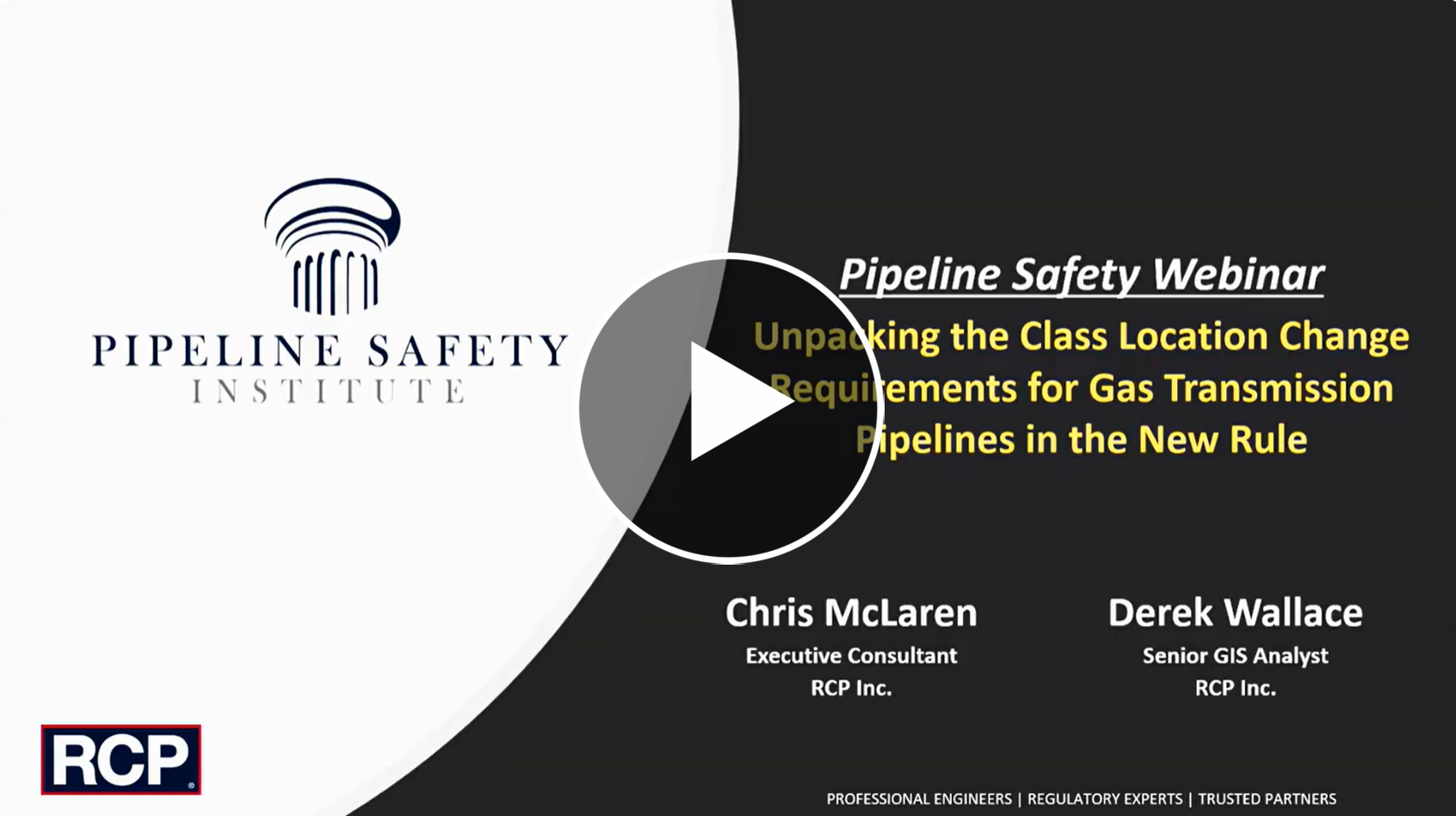
WEBINAR RECORDING
Pipeline Safety: Unpacking the Class Location Change Requirements

Thank you to everyone who attended and participated in this informative webinar. The session recording is posted to our YouTube channel. Please watch, like, and subscribe to our channel!
You asked and we listened!

Advanced DOT Pipeline Compliance Workshop is on the calendar!

This intensive and interactive 3-day, in-person workshop is designed for those who have previously completed our DOT Pipeline Compliance Workshop and are ready to take their knowledge to the next level.

New Workshop Alert!

Prepare Your Team for Pipeline Safety Audits with Confidence!

Our 3-day Pipeline Safety Audit Workshop is tailored for professionals responsible for the safe operation of hazardous liquid and natural gas pipelines. Designed for groups of 10-15 participants, this interactive training…

On-Site Training Request

We have conducted on-site training for oil and gas companies for over 25 years and can provide customized workshops for companies with groups of five or more.

We would welcome the opportunity to discuss our services with you.

Sincerely,

W. R. (Bill) Byrd, PE
President
RCP Inc.