RCP Welcomes Ron McCoy

RCP is pleased to announce that Mr. Ron McCoy has joined the firm as Vice President for Business Development and Project Management. Mr. McCoy brings a wealth of experience in the major business areas of the pipeline industry. He has extensive experience in engineering design, construction, operations, and regulatory affairs (both FERC and OPS). Mr. McCoy has been Project Manager for the engineering and construction of numerous domestic and international liquid and gas pipelines, including offshore pipelines in water depths of one thousand feet. Other unusual projects included in Mr. McCoy’s portfolio include pipeline systems operating above the fluid’s cricondenbar, installations in sensitive/hazardous areas, and pipelines connecting to major international oil and gas producing facilities. Mr. McCoy is well versed in all phases of pipeline design, construction, and operations, including integrity management and risk analysis. Mr. McCoy was Facilities Engineering Manager for Mobil’s Statfjord Unit in Norway, responsible for engineering the field’s gas gathering pipeline system and treating facilities. Previously, he served as Operations Manager for the Sacroc carbon dioxide pipeline system in West Texas. This system was the first operating carbon dioxide pipeline system in the United States.

Mr. McCoy is also well experienced in all phases of pipeline regulation by both OPS and the FERC. He was an active participant in the natural gas industry’s deregulation through FERC Orders 436, 451 and 636, and has served as expert witness at both the federal and state levels. He was Gas Marketing Director for an 11 trillion cubic feet natural gas field development in South America, and advised the local regulatory body on the development of gas pipeline and distribution system regulations.

Mr. McCoy received his bachelor's degree in Aerospace Engineering from Texas A&M; University and is a Professional Engineer in the State of Texas.

Pipeline Integrity Management in High Consequence Areas

Pipeline Integrity Management in High Consequence Areas (Hazardous Liquid Operators With Less Than 500 Miles of Pipelines):

On March 21, 2001, RSPA proposed a rule to extend the requirements for protection of populated areas, commercially navigable waterways, and areas unusually sensitive to environmental damage from hazardous liquid pipeline spills to those regulated hazardous liquid pipeline operators who own or operate less than 500 miles of pipeline. This action builds upon the December 01, 2000, final rule that applied only to hazardous liquid pipeline operators who own or operate 500 or more miles of pipeline. After further review, it was determined that the same requirements should be extended to the remaining regulated hazardous liquid pipeline operators. The sole difference is in compliance dates which are linked to the effective date of this final rule. Because this proposed rule, and thus the eventual final rule, will be published at a later date, the compliance dates in this proposed rule will be accordingly shifted to give the operators with less than 500 miles of pipeline the same amount of time to comply with the requirements. If comments to this proposed rule cause RSPA to impose different requirements on those regulated operators with less than 500 miles of pipelines, we will distinguish those requirements in the final rule. Also, the December 1, 2000 final rule proposed repair criteria that may be changed based on comments. Any changes to that proposal will also be reflected in the final rule for small liquid operators.

The proposed rule for Hazardous Liquid Operators with less the 500 miles of pipelines is available on RCP's website HERE. See RCP's December 2000 pipeline newsletter for a description of the hazardous liquid pipeline integrity rulemaking requirements HERE.

Upcoming RCP Seminars:

RCP will conduct a 2 day workshop on DOT Pipeline Regulations on May 15 and 16th in Houston. This workshop will present an overview of all the current DOT regulations for pipeline operators, including recent regulatory initiatives such as operator qualification and pipeline integrity management. It will be followed by a half day workshop on May 17th dedicated to OPA-90 oil spill response planning for DOT pipelines. Both of these workshops are suitable for personnel who need a general introduction to DOT pipeline regulatory requirements. Additional information is available on our website HERE.

RCP will repeat our 2 day workshop on Pipeline Integrity Management on July 17 and 18th in Houston. This workshop presents a detailed analysis of the recent federal Pipeline Integrity Management regulation and the management programs / elements that it requires. We will also review recent state initiatives / proposed rules on pipeline integrity management. On the 18th we will discuss various methods of actually conducting a risk assessment for pipeline segments, and will work though several hands-on examples. We received very positive feedback from the Pipeline Integrity Management workshop that we conducted in March, and expect the July session to fill up rapidly. Additional information is available on our website HERE.

Mechanical Damage Status Meeting

RSPA, along with GTI, invite the pipeline industry, in-line inspection ("smart pig") vendors, and the general public to a meeting to review the status of a two-year research program to identify and characterize mechanical damage using magnetic flux leakage (MFL) inspection tools. The meeting will be held on Wednesday, April 18, 2001 from 2 to 5 p.m. at the Marriott Rivercenter Hotel, 101 Bowie, San Antonio, TX, and is open to anyone (no registration is required). The meeting will cover a review of the overall project plan, the status of the contract tasks, progress made during the past quarter, and projected activity for the next quarter. FOR FURTHER INFORMATION CONTACT: Lloyd W. Ulrich, Agreement Officer's Technical Representative, Office of Pipeline Safety, telephone: (202) 366-4556, FAX: (202) 366-4566, e-mail: lloyd.ulrich@rspa.dot.gov. You may also contact Harvey Haines, Principal Investigator, GTI, telephone: (773) 399-8223, FAX: (773) 864-3495, e-mail: harvey.haines@gastechnology.org.

This research continues work that DOT supported at Battelle to improve in-line inspection of mechanical damage and more closely coordinates work that GTI is supporting at Southwest Research Institute to develop critical assessment criteria based on these NDE measurements. This program extends the work conducted under the RSPA-funded contract "Detection of Mechanical Damage in Pipelines" (Contract DTRS-56-96-C-0010)1 by looking at the circumferential magnetic flux leakage field instead of the traditional axial field and extends the critical assessment criteria research to work with full scale samples that are being used for MFL measurements. The goal of the research is to evaluate and develop techniques for assessing pipeline metal loss, mechanical damage, and cracks using circumferential MFL. These techniques are expected to complement the techniques used for axial MFL systems.

The research will extend the failure assessment methodology for mechanically damaged pipes to include the influence of local cold working due to the gouging/denting process on the pipe's remaining life. The program will combine full scale tests and MFL monitoring of pipes, laboratory tests and elastic-plastic finite element analyses to develop a validated methodology for determining the remaining life of a damaged pipe. The proposed SwRI research will complement the work at Battelle in developing criteria for characterizing mechanical damage found through in-line inspection.

On Thursday morning, April 19, 2001, Southwest Research Institute will offer a tour to anyone interested in the facilities used in this research project. Interested parties should contact Al Crouch at SwRI, (210) 522-3157.

Proposed Hazardous Liquid Pipeline Accident Reporting Revisions

On March 20, 2001, RSPA published a notice of proposed rulemaking in the federal register (66 FR 15681) to lower the existing threshold for accident reporting for operators of hazardous liquid pipeline systems subject to RSPA regulations under Part 195. The existing threshold of 50 barrels would be lowered to the new threshold of 5 gallons. The reporting burden for small spills would be minimized by collecting only minimal information for spills from 5 gallons to less than 5 barrels, except where a spill of 5 gallons or more occurs in water. Spills between 5 gallons and less than 5 barrels that occur during normal maintenance activities are exempt if they are confined to the operator's property or pipeline right-of-way and they are cleaned up without delay. A spill of 5 or more barrels, or any accident reportable by the already existing criteria specified in section 195.50 will, as at present, require complete reporting. Comments on the subject of this proposed rule must be received on or before May 21, 2001 (docket number RSPA-01-8663).

The hazardous liquid accident form will also be revised to improve its usefulness. On the revised accident form, reporting for spills from less than 5 barrels down to 5 gallons will require reporting minimal information, whereas any spill in water of 5 gallons or more, any spill of 5 barrels or more, or where otherwise reportable according to existing reporting criteria as outlined in 49 CFR 195.50, will require completion of the entire new proposed accident report. Additionally, RSPA proposes to further improve the usefulness of the information collected on the hazardous liquid accident form RSPA F 7000-1 by strengthening the cause and consequence detail information on the accident report. The proposed new reporting form and instructions can be downloaded from RCP's website here (FORM)(INSTRUCTIONS).

RSPA acknowledges the need for consistent pipeline information for both natural gas and hazardous liquid pipeline accidents. Plans are currently underway to similarly revise natural gas transmission incident pipeline information. RSPA also plans to adopt a similar failure cause scheme for natural gas distribution pipeline incidents later in 2001. By adopting recognized industry proposed failure causal categories for natural gas and hazardous liquid pipeline incidents, RSPA is taking a step toward further standardization of pipeline safety statistics for all pipeline types, increasing the overall usefulness of the data, and making analysis more efficient and meaningful.

Duke Energy Waiver

On March 9, 2001, the Office of Pipeline Safety (OPS) published their approval of a waiver of certain regulatory requirements relating to class location changes on fifteen natural gas pipeline segments (the "waiver segments") operated by Duke Energy (Duke), permitting Duke to carry out alternative risk control activities (the "Activities") in lieu of compliance with these requirements. The waiver segments are located on the three parallel lines 10, 15, and 25, downstream from the Mt. Pleasant Compressor Station. The waiver segments lie in Maury and Williamson Counties, Tennessee. The waiver segments include five locations in a 3-line system, ranging from 0.5 miles to 0.88 miles in length and totaling 12.2 miles. See our January 2001 DOT Pipeline newsletter for further details of the waiver request.

Advisory Bulletin – Gas shutoff to Permanently Moored Vessels

On March 9, the Office of Pipeline Safety (OPS) published an advisory to gas distribution pipeline system operators. Operators should examine the location of shut-off valves controlling gas service to permanently moored vessels (PMV) and ensure that gas service can be quickly shut down, if necessary, even during high-water conditions. If not, the valves should be moved to a location above the reasonably anticipated high-water mark or equipped to be readily accessible during high-water events. In addition, operators should review their operations and maintenance manual and their emergency response manual to ensure that procedures are in place to successfully shut down the flow of gas to PMVs when necessary, including during high-water conditions.

This advisory is a result of NTSB's investigation of a natural gas leak on a permanently moored vessel (PMV), the President Casino on the Admiral (Admiral), on April 4, 1998. The Admiral was struck by barges that detached from a tow during high-water conditions on the Mississippi River in downtown St. Louis, Missouri. The Admiral lost most of its mooring lines, causing the barge to rotate away from the quay, severing the gas service line. The natural gas did not ignite, but an emergency repair crew was unable to shut off the gas supply because the flooded regulator pit made it impossible to reach the shut-off valve. After three hours the crew was able to clamp-off the line and stop the flow of gas.

There are hundreds of PMVs in U.S. waters. This incident highlights the need to evaluate the accessibility and operability of gas service line valves serving PMVs. Although not all these valves are subject to potential high-water conditions, gas distribution pipeline system operators serving PMVs should ensure that they can promptly shut down the flow of natural gas to PMVs, even during high-water conditions.

Editor's Note: This same advice applies to any vessel that has shoreside connections to natural gas pipelines, whether permanently moored or not. It also applies to companies that install and operate these pipelines, even if they are not regulated Local Distribution Companies.

FERC Meeting

FERC Meeting: Notice of Fourth Interstate Natural Gas Facility-Planning Seminar:

The Federal Energy Regulatory Commission Office of Energy Projects will hold the fourth in a series of public meetings around the country for the purposes of exploring and enhancing strategies for constructive public participation in the earliest stages of natural gas facility planning. This meeting will be held in Seattle, Washington on Thursday, April 26, 2001. FERC is inviting interstate natural gas companies; Federal, state and local agencies; landowners and non-governmental organizations with an interest in developing a new way of doing business to join in this effort.

Participants will discuss the facility planning process, the potential benefits of pipeline facilities, and ways of improving the environmental review process for interstate natural gas pipeline projects. The staff of the Commission's Office of Energy Projects will give a briefing on the results of our first three seminars in Albany, NY, Chicago, IL, and Tampa, FL, including problems that were identified and potential solutions that were offered in the seminars.

The meeting will be held at the Washington Athletic Club, 1325 Sixth Avenue, Seattle, Washington 98101 (click here for a map and directions). The meeting is scheduled to start at 9 a.m. and finish at 2:30 p.m. If you plan to attend, please email lloyd.ulrich@rspa.dot.gov by April 20, 2001. Or, you can respond via facsimile to Pennie Lewis-Partee at 202-208-0353. Please include in the response the names, addresses, and telephone numbers of all attendees from your organization. FERC will send an acknowledgment of your request. Please consider issues and/or questions you would like to have addressed at the meetings and email them to FERC. Additional meetings are being considered in the Boston, Massachusetts/Portland, Maine area in May/June, 2001, and in the Reno, Nevada or Salt Lake City, Utah area in July/August, 2001. Comments on these proposed future meetings can also be directed to FERC as described above.

EPCRA/TRI Training workshops

EPA will conduct EPCRA/TRI Training workshops across the country during the spring of 2001. These workshops are intended to assist persons preparing their annual reports on release and other waste management activities as required under sections 313 of the Emergency Planning and Community Right-To-Know Act of 1986 (EPCRA) and section 6607 of the Pollution Prevention Act of 1990 (PPA). These reports must be submitted to EPA and designated state officials on or before July 1, 2001. Information concerning the EPCRA/TRI Training workshops is available on EPA's web site at http://www.epa.gov/tri.

Acquiring a pipeline?

RCP can provide due diligence audits to help you ensure that potential compliance issues have been addressed before the sale is final.

Pending Audits?

Has the DOT notified you of a pending audit? RCP can provide confidential internal auditing to help ensure that your facilities are up to the agency's latest standards.

Help Wanted

Know someone with regulatory expertise who is interested in full or part time work? Our recruiting coordinator would be glad to get their resume! Have them sent to chandra@your-rcp.com, or FAX to 713-655-8083.

Visit Regulatory Compliance Partners on the Web at

http://www.your-rcp.com

or call us at 1-888-RCP-X-YES to see what we can do for you.

Ongoing Resources

These articles are maintained and updated as new information becomes available.

Last Updated: October 2026

Regulatory Watch: Key Dates & Deadlines

Welcome to Regulatory Watch! In this monthly update, we’ll keep you informed on proposed rule comment periods, effective dates, and upcoming deadlines for various compliance requirements.

2137-AF63Proposed Rule Stage

Administrative Rulemaking Regulatory Procedures

ProposedDate not available
FinalNot yet published
ImplementationNot yet established
Regulatory WatchImplementation Stage

All Liquid HCA segments capable of ILI § 195.452(n)

ProposedDate not available
FinalDate not available
ImplementationJul 2, 2040
2137-AF45Proposed Rule Stage

Amendments to Liquefied Natural Gas Facilities

ProposedDate not available
FinalNot yet published
ImplementationNot yet established
2137-AG22Proposed Rule Stage

Breakout Tank

ProposedDate not available
FinalNot yet published
ImplementationNot yet established
2137-AF61Final Rule Stage

Cost Recovery for Siting Reviews for LNG Facilities

ProposedDate not available
FinalDate not available
ImplementationNot yet established
2137-AF51Final Rule Stage

Gas Pipeline Leak Detection and Repair

ProposedDate not available
FinalDate not available
ImplementationNot yet established
Regulatory WatchImplementation Stage

Gas Transmission: Assessments Outside HCAs § 192.710

ProposedDate not available
Public comments ClosedCloses Sep 8, 2026
FinalDate not available
ImplementationJul 1, 2034
2137-AF37Proposed Rule Stage

Oil Spill Response Plans, Accident Notifications, Inspections and Investigations and other Miscellaneous Pipeline Safety Changes

ProposedDate not available
FinalNot yet published
ImplementationNot yet established
2137-AF52Proposed Rule Stage

Pipeline Operational Status

ProposedDate not available
FinalNot yet published
ImplementationNot yet established
2137-AF44Proposed Rule Stage

Repair Criteria for Gas and Hazardous Liquid Pipelines

ProposedDate not available
FinalNot yet published
ImplementationNot yet established
2137-AF60Proposed Rule Stage

Safety of Carbon Dioxide and Hazardous Liquid Pipelines

ProposedDate not available
FinalNot yet published
ImplementationNot yet established
2137-AF53Final Rule Stage

Safety of Gas Distribution Pipelines and Other Pipeline Safety Initiatives

ProposedDate not available
FinalDate not available
ImplementationNot yet established

Sprint I & II Update

To further the Administration’s deregulatory policies, PHMSA has published in today’s Federal Register twenty-eight (28) separate rulemaking actions affecting the pipeline safety regulations (PSR; Parts 190-199). Click here to access the documents.

Rulemaking Description Stage Code
Pipeline Safety: Rationalize Special Permit Conditions PHMSA proposes to amend its special permit procedures to ensure permit conditions are directly tied to the specific pipeline safety regulations being waived. NPRM 49 CFR Part 190
Pipeline Safety: Rationalize Calculation of Regulatory Filing and Compliance Deadlines PHMSA will clarify that regulatory filing and compliance deadlines falling on weekends or Federal holidays automatically move to the next business day. DFR 49 CFR Part 190
Pipeline Safety: Adjust Annual Report Filing Timelines PHMSA will amend annual reporting requirements to move the gas pipeline annual report submission deadline from March to June. DFR 49 CFR Part 191
Pipeline Safety: Property Damage Definition for Incident Reporting PHMSA will clarify incident reporting property damage calculations for gas pipelines and update hazardous liquid accident reporting thresholds using inflation-adjusted criteria. DFR 49 CFR Parts 191 & 195
Pipeline Safety: Exception for In-Plant Piping Systems PHMSA proposes to clarify that in-plant piping systems are not subject to federal pipeline safety regulations. NPRM 49 CFR Part 192
Pipeline Safety: Codify Enforcement Discretion on Incidental Gathering Lines PHMSA proposes to codify enforcement discretion clarifying that restrictions on the historical incidental gathering line exemption apply only to newly constructed lines. NPRM 49 CFR Part 192
Pipeline Safety: Eliminate Burdensome Coating Assessment Deadlines PHMSA proposes to replace prescriptive deadlines for coating damage assessments and remediation with a requirement that activities be completed before the pipeline is placed in service. NPRM 49 CFR Part 192
Pipeline Safety: Atmospheric Corrosion Reassessment for Pipeline Replacements PHMSA proposes to remove the 3-year reassessment interval following replacement of atmospheric corrosion defects and allow use of the standard 5-year reassessment interval. NPRM 49 CFR Part 192
Pipeline Safety: Harmonize Class Change Pressure Test Requirements PHMSA proposes to reduce the minimum pressure test duration following certain class location changes from 8 hours to 4 hours, aligning with existing Subpart J requirements. NPRM 49 CFR Part 192
Pipeline Safety: Clarify MAOP Reconfirmation Testing Records PHMSA will issue a technical correction clarifying that operators may use pre-1970s pressure test records when reconfirming MAOP under §192.624. Final Rule 49 CFR Part 192
Pipeline Safety: Remote Sensing Technologies for ROW Patrols PHMSA will explicitly allow right-of-way patrols to be conducted using unmanned aircraft systems, satellites, and other remote sensing technologies. DFR 49 CFR Parts 192 & 195
Pipeline Safety: Technical Standards Updates and Amendments PHMSA will update incorporated standards and make technical amendments in response to an industry petition for reconsideration. Final Rule 49 CFR Part 192
Pipeline Safety Program: Update of Standards Incorporated by Reference PHMSA issued multiple direct final rules updating incorporated industry consensus standards used throughout Parts 192 and 195, replacing outdated editions with current versions. Multiple DFRs 49 CFR Parts 192 & 195

The following is a summary of the 40 rulemakings that PHMSA published in the Federal Register on April 24, 2026. If any adverse comment is received to a DFR PHMSA must rescind the rule and repropose. Click here to access the documents.

Rulemaking Description Stage Code
Pipeline Safety and Hazardous Materials Safety: Amendments to PHMSA Procedural Regulations PHMSA proposed miscellaneous amendments to procedural regulations governing informal rulemaking for both pipeline safety and hazardous materials programs. NPRM 49 CFR Part 190
Pipeline Safety: Interpretation Request Procedures PHMSA amended interpretation procedures to require publication of interpretation requests on its website and provide an opportunity for public comment. Final Rule 49 CFR Part 190
Pipeline Safety: Declaratory Order Procedures PHMSA established formal procedures for issuing declaratory orders through a new section in Part 190. Final Rule 49 CFR Part 190
Pipeline Safety: Consent Orders PHMSA clarified that consent agreements may be used to resolve enforcement actions, including cases involving civil penalties. Final Rule 49 CFR Part 190
Pipeline Safety: Adjustment to OPID Notifications for Construction PHMSA proposed adjusting the inflation-based threshold that triggers OPID notifications for certain construction and facility modification activities. NPRM 49 CFR Part 191
Pipeline Safety: Eliminating Limitations on Welders and Welding Operators PHMSA proposed allowing welders qualified through non-destructive testing methods to perform compressor station welding activities currently subject to additional restrictions. NPRM 49 CFR Part 192
Pipeline Safety: Material Properties Verification During MAOP Reconfirmation PHMSA proposed clarifying that material testing at pressure test manifold sites is not required when traceable, verifiable, and complete material records already exist. NPRM 49 CFR Part 192
Pipeline Safety: Electronic Retention of Part 194 Response Plans PHMSA amended regulations to allow operators to maintain electronic copies of response plans instead of paper copies. DFR 49 CFR Part 194
Pipeline Safety: Remote Monitoring of Rectifiers PHMSA proposed allowing remote monitoring technologies for rectifiers used in external corrosion control programs. NPRM 49 CFR Part 195
Pipeline Safety: Clarifying Hazardous Liquid High-Consequence Area Designations PHMSA amended HCA guidance to clarify spill considerations in agricultural fields and reorganize threat identification guidance. DFR 49 CFR Part 195
Pipeline Safety: Timeframe to Make Rupture-Mitigation Valves Operational PHMSA proposed extending the deadline for placing rupture-mitigation valves into operation from 14 days to 90 days after a pipeline enters service. NPRM 49 CFR Part 192
Pipeline Safety: Hazardous Liquid Valve Maintenance Schedule PHMSA proposed allowing operators to implement risk-based valve maintenance schedules, subject to a maximum inspection interval of one year. NPRM 49 CFR Part 195
Pipeline Safety: Property Damage Definition for Incident Reporting PHMSA proposes revising property damage thresholds for reportable gas and hazardous liquid pipeline incidents and clarifying applicability to telephonic notifications. NPRM 49 CFR Parts 192 & 195
Pipeline Safety: Remote Sensing Technologies for ROW Patrols PHMSA proposes clarifying that unmanned aerial systems, satellites, and other remote-sensing technologies may be used to satisfy right-of-way patrol requirements. NPRM 49 CFR Parts 192 & 195
Pipeline Safety: Adjust Annual Report and NPMS Filing Timelines PHMSA proposes extending annual report and NPMS submission deadlines for gas pipeline and storage operators to June 15 each year. NPRM 49 CFR Part 191
Pipeline Safety: Editorial Corrections and Clarifications PHMSA issued multiple final rules correcting editorial errors, updating references, removing obsolete submission methods, and improving regulatory clarity. Final Rules Various
Pipeline Safety: Update of Standards Incorporated by Reference PHMSA issued multiple direct final rules updating incorporated industry consensus standards, including NFPA, ASTM, MSS, NACE, and ASME standards. Multiple DFRs 49 CFR Parts 192 & 195

Have questions about an upcoming deadline? Please reach out to Jessica Foley for assistance!

Last Updated: October 2026

Conference News

Jan252027

Pipeline Pigging and Integrity Management Conference

▦ January 25, 2027 – January 28, 2027⌖ George R. Brown Convention Center, Houston, TX

The 39th International Pipeline Pigging & Integrity Management Conference (PPIM) will take place at the George R. Brown Convention Center in Houston. The event brings together pipeline operators, engineers, and industry professionals to explore advancements in pipeline inspection, integrity management, risk assessment, and emerging technologies.…

ExhibitingBooth 524
RCP Team Attending
Heather RoarkHeather RoarkSales & Marketing Coordinator

Jessica FoleyJessica FoleyVice President
Featured Presentations
Chris McLaren
Chris McLarenExecutive Consultant
October 27, 2026 at 7:30 AM
Event Details
Last Updated: October 2026

PSI Training Schedule

Date Training Course Price Registration
Nov 17 – Nov 19, 2026 DOT Pipeline Compliance Workshop $2,150 SOLD OUT
Feb 16 – Feb 18, 2027 Pipeline Safety Audit Training $2,150 Register →
Feb 23 – Feb 25, 2027 Advanced Pipeline Risk Assessment Workshop $2,150 Register →
Mar 23 – Mar 25, 2027 DOT Pipeline Compliance Workshop $2,150 Register →

WEBINAR RECORDING!
Unpacking the Key Updates in API RP 1170 & 1171, 2nd Edition

RCP and the Pipeline Safety Institute offered a free webinar exploring the 2nd Editions of API RP 1170, Design and Operation of Solution-mined Salt Caverns Used for Natural Gas Storage and API RP 1171, Functional Integrity of Natural Gas Storage in Depleted Hydrocarbon Reservoirs and Aquifer Reservoirs. Thank you to everyone who attended and participated in this informative webinar. The session recording is posted to our YouTube channel. Please watch, like, and subscribe to our channel!

WEBINAR RECORDING
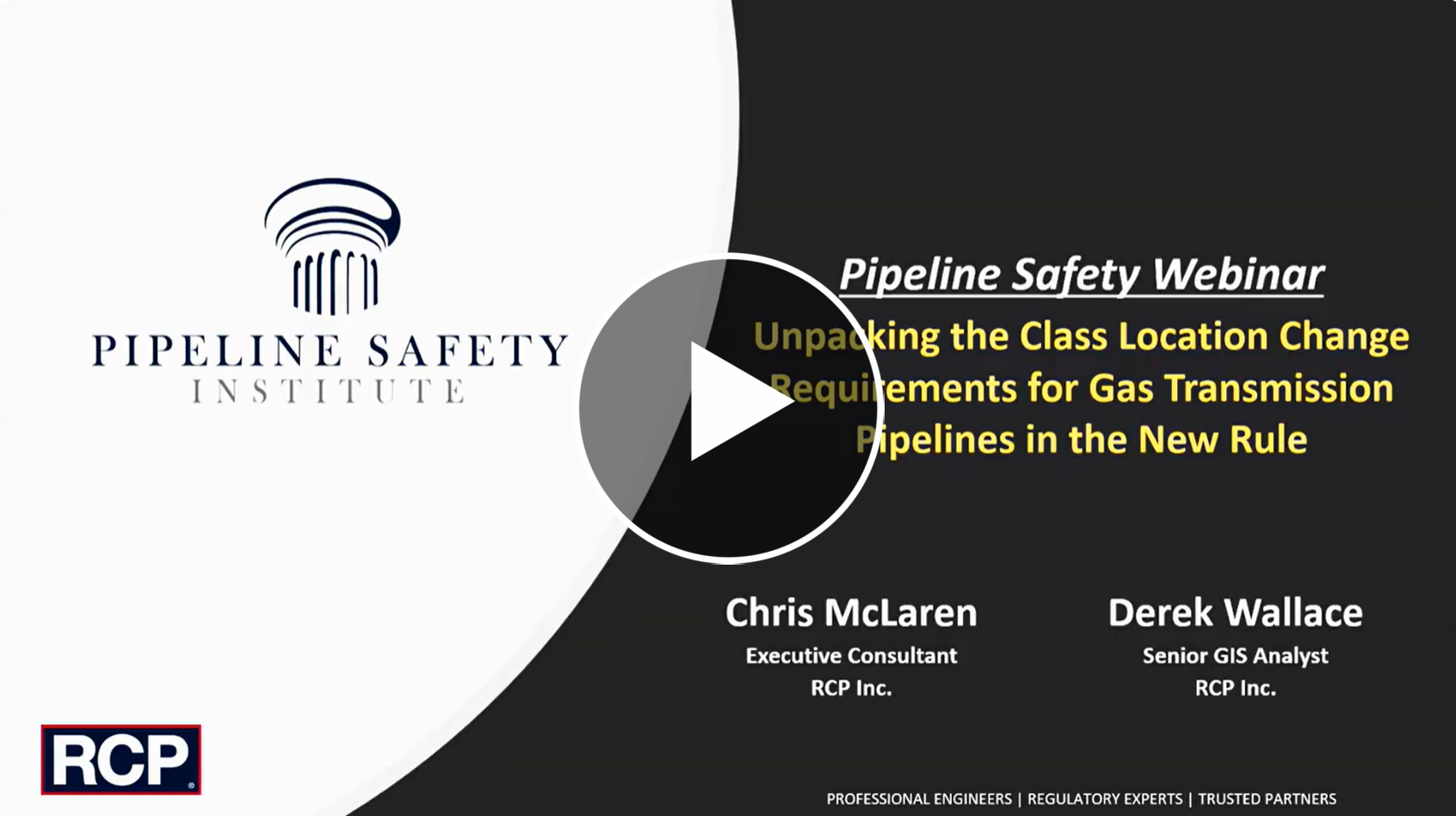
Pipeline Safety: Unpacking the Class Location Change Requirements

Thank you to everyone who attended and participated in this informative webinar. The session recording is posted to our YouTube channel. Please watch, like, and subscribe to our channel!
You asked and we listened!

Advanced DOT Pipeline Compliance Workshop is on the calendar!

This intensive and interactive 3-day, in-person workshop is designed for those who have previously completed our DOT Pipeline Compliance Workshop and are ready to take their knowledge to the next level.

New Workshop Alert!

Prepare Your Team for Pipeline Safety Audits with Confidence!

Our 3-day Pipeline Safety Audit Workshop is tailored for professionals responsible for the safe operation of hazardous liquid and natural gas pipelines. Designed for groups of 10-15 participants, this interactive training…

On-Site Training Request

We have conducted on-site training for oil and gas companies for over 25 years and can provide customized workshops for companies with groups of five or more.

We would welcome the opportunity to discuss our services with you.

Sincerely,

W. R. (Bill) Byrd, PE
President
RCP Inc.