
- DOT Pipeline Compliance Workshop – February 25 & 26, 2009
- New Jersey Damage Prevention Regulations – Proposed Changes
- PHMSA Final Rule: Polyamide-11 (PA-11) Plastic Pipe Design Pressures
- New NPMS Data Submission Guidelines
- SPCC Revision Highlights
- New Drill Rules for Gas Wells in Texas
- Technical Advisory Committee Meetings for DIMP and CRM
- API Public Awareness Workshop
- API Pipeline Conference and Safety, Environmental, and Distinguished Award Program
- Regulatory Watch: Key Dates & Deadlines
- Conference News
- PSI Training Schedule
DOT Pipeline Compliance Workshop – February 25 & 26, 2009
DOT Pipeline Compliance Workshop – February 25 & 26, 2009
RCP will be hosting our very popular 2-day workshop on DOT Pipeline Compliance on February 25 & 26, 2009, in Houston, TX. Join us for an informative, lively, and interactive workshop on DOT Pipeline Compliance.
Day 1 (February 25): Gas Pipeline Regulations (49CFR192): Covering all the topics below but special emphasis will be placed on the changes in **GAS GATHERING** regulations.
Day 2 (February 26): Liquid Pipeline Regulations (49CFR195)
Each day of the workshop will address the following issues as they specifically relate to either Gas or Hazardous Liquid pipelines:
- PHMSA Overview
- PHMSA Jurisdictional Boundaries
- Compliance Requirements:
- New/Proposed Regulations – including liquid rural low stress and new gas production pipeline rules in Texas and other states.
For additional information go to our website here.
Save the Dates!
RCP DOT Workshops in 2009
February 25 & 26 (Wednesday & Thursday) – Houston, TX
June 2 & 3 (Tuesday & Wednesday) – Houston, TX
October 6 & 7 (Tuesday & Wednesday) – Houston, TX
Visit our Seminars webpage for updates & registration information.
New Jersey Damage Prevention Regulations – Proposed Changes
BPU Docket Number: AX08090838; Proposal Number: PRN 2008-411
The New Jersey Board of Public Utilities (Board) is proposing amendments, repeal and new rules to its One-Call Damage Prevention System rules, N.J.A.C. 14:2. These rules implement the Underground Facility Protection Act, N.J.S.A. 48:2-73 et seq., which requires the Board to establish and maintain a program for the protection of underground facilities used for the conveyance of water, forced sewage, telecommunications, cable television, electricity, oil, petroleum products, gas, optical signals, traffic control or for the transportation of a hazardous liquid subject to the Federal Hazardous Liquid Pipeline Safety Act of 1979. This notice of proposal is intended to correct and clarify provisions relating to excavations for pest management purposes, to increase penalties for violations relating to natural gas and hazardous liquid facilities and to streamline the One-Call program enforcement procedures consistent with the enforcement procedures in the Board's natural gas pipeline rules.
The proposed amendments and new rules include extensive changes to the Board's procedures for handling violations of the One-Call rules. These proposed procedures will match those proposed for use under the Board's natural gas pipeline safety rules at N.J.A.C. 14:7-2. See 40 N.J.R. 4915(a). The proposed amendments and new rules add a great deal of detail regarding enforcement procedures. However, most of this added detail merely describes the Board's existing procedures. Under the existing penalty system, Board staff first issues a notice of probable violation (NOPV). If the alleged violator does not respond within the deadline in the NOPV, the Board may then issue an administrative order and/or assess a penalty. Only after this second Board action becomes final does the penalty become due and owing. This system requires Board staff to obtain Board approval twice for the same penalty for the same violation. Under the proposed changes, Board staff need seek Board approval only once. The amendments provide for the Board to assess a penalty through a staff-issued NOPV, which ultimately must be approved by the Board; or through a Board-issued administrative order and notice of civil administrative penalty assessment. Although the procedure is streamlined, in all cases the Board must approve the assessment of the penalty and the penalty amount.
The enforcement provisions proposed herein accomplish two goals. First, they streamline and systematize the Board's penalty and enforcement procedures, consistent with the enforcement procedures in the Board's natural gas pipeline safety rules at N.J.A.C. 14:7-2. Second, these proposed amendments and new rules implement recent statutory amendments that increase the penalties for violations of the One-Call rules that relate to underground facilities carrying natural gas or hazardous liquids.
Comments may be submitted through February 13, 2009, to rule.comments@bpu.state.nj.us (use Microsoft WORD or compatible format).
Damage Prevention Plans
RCP can develop or update your Damage Prevention plan. For more information about how RCP can assist you with your Damage Prevention Plan, click here.
PHMSA Final Rule: Polyamide-11 (PA-11) Plastic Pipe Design Pressures
The Department of Transportation / Pipeline Hazardous Materials Safety Administration (PHMSA) issued a final rule that amends the design factor and design pressure limits for natural gas pipelines made from new Polyamide-11 (PA-11) thermoplastic pipe. These two changes in the regulations allow pipeline operators to operate certain pipelines constructed of new PA-11 pipe at higher operating pressures than is currently allowed for other plastic pipe materials. PHMSA published a Notice of Proposed Rulemaking (NPRM) (73 FR 1307; January 8, 2008) proposing to increase the design factor and corresponding operating pressure limitations for natural gas pipelines made from new PA-11 thermoplastic pipe. PHMSA is adopting the amendments as proposed in the NPRM with four exceptions:
- Adding the term "copper tubing size (CTS)" to clarify that pipeline operators may use copper tube size pipe as well as iron pipe size pipe. IPS means Iron Pipe Size, while CTS means copper tube size. These are recognized pipe size standards that refer to a nominal pipe diameter, not to the actual inside diameter (ID) or outside diameter (OD) of a pipe. IPS is generally used for pipe sizes 2 inches or greater; CTS is generally used for pipe sizes 2 inches or less.
- Adding the term "thicker pipe wall" to clarify that "SDR-11 or greater" means pipe with thicker pipe wall.
- Clarifying that the use of arithmetic interpolation to determine a design pressure rating at a specified temperature (i.e., "S" in the plastic pipe design formula in § 192.121) will not be allowed for PA-11 pipe.
- Not requiring that pipe with design pressures above 100 psig (689 kPa) be buried with a warning tape or other device designed to warn an excavator of the presence of a high pressure gas line.
The final rule amends the existing plastic pipe design formula in § 192.121 to cover pipelines made from new 4-inch IPS (or CTS) or less, SDR-11 or greater (i.e., thicker pipe wall) PA-11 pipe with a design factor of up to 0.40 and increases the design pressure limitation in § 192.123 to 200 psig (1379 kPa) for these same pipelines. The design factor for all other plastic pipes remains as prescribed in the existing regulations.
These rule changes are effective January 23, 2009.
For a copy of the Final Rule: Polyamide-11 (PA-11) Plastic Pipe Design Pressures, contact Jessica Roger.
New NPMS Data Submission Guidelines
The National Pipeline Mapping System (NPMS) has issued a new set of guidelines for annual pipeline data submissions. These new guidelines apply to DOT/PHMSA-regulated pipelines, breakout tanks, and LNG facilities.
- Beginning January 1, 2009, annual NPMS data submissions should be made at the same time as hazardous liquid transmission and gas transmission annual report submissions. The due date for gas transmission reports is March 15 and the due date for hazardous liquid reports is June 15.
- Data submittals must be accompanied by a transmittal letter, the format of which is detailed in the new guidelines.
- Beginning December 15, 2008 attribute data and metadata must be revised according to the new guidelines or submittals will be rejected. Changes include a more detailed product description and more specific codes for pipeline changes.
- Beginning December 15, 2008, abandoned pipelines should only be submitted to NPMS once. Following the first submittal, abandoned pipelines should be removed from all subsequent submittals. If a pipeline has already been submitted as abandoned, it should be removed from the operator’s data before the next annual submittal.
- NPMS has released an updated version of its attribute and metadata creation software. Any attributes or metadata created with the previous version of the software will be rejected as unacceptable. The new software is available here for download.
- Digital data submittals are strongly encouraged, as are early submittals.
RCP is highly experienced with NPMS submittals and is fully equipped to update existing NPMS data to meet the new standards or to generate new submittals. For a copy of the new NPMS Guidelines, or for more information, contact Jessica Roger.
RCP & ESRI Business Partner Program
RCP is pleased to announce our partnership with ESRI in providing consulting services to GIS users. ESRI designs and develops the world's leading geographic information system (GIS) technology. RCP's staff includes GIS and mapping experts that conduct high consequence area (HCA) identification, risk assessment, class location analysis, underwater inspections, NPMS/RRC submittals, spill modeling, as well as other spatial analysis projects. For more information, contact Jessica Roger.
SPCC Revision Highlights
The EPA recently revised the language in the SPCC regulations found in 40 CFR 112. The changes are fairly extensive, but are summarized for your convenience. For more information, please contact Jessica Roger.
Facility Definition
The amendments modify the definition of “facility” so that owners and operators may separate or aggregate containers to determine facility boundaries based on ownership or operation of the buildings, structures, containers, and equipment on the site, the activities being conducted, and property boundaries.
Navigable Waters Definition
The term “navigable waters” of the United States, for purposes of the SPCC regulations, was returned to its 1973 definition, and includes:
- All navigable waters of the United States, as defined in judicial decisions prior to the passage of the 1972 Amendments to the CleanWater Act (CWA) and tributaries of such waters
- Interstate waters
- Intrastate lakes, rivers, and streams that are used by interstate travelers for recreational or other purposes
- Intrastate lakes, rivers, and streams from which fish or shellfish are taken and sold in interstate commerce
Facility Diagram
SPCC plan facility diagrams must indicate all fixed containers. However, under the amendments, for any mobile or portable container, owners and operators must mark only the area of the facility on the diagram where such containers are stored, rather than representing each container individually. Owners and operators may include such information separately in the SPCC plan in an accompanying table or key rather than on the facility diagram. If the total number of mobile or portable containers changes, owners and operators may indicate the potential range in number of containers and the anticipated contents and capacities of containers.
Loading/Unloading Racks
EPA specifically excluded loading and unloading racks from SPCC requirements in 40 CFR 112.7(h) at oil production facilities and farms because they are generally not found at those facilities. If an oil production facility or farm does have a loading/unloading rack, it is subject to the general secondary containment requirements. The amendments also change all references from loading/unloading “area” to loading/unloading “rack” to provide clarity in the rule’s applicability.
Qualified Facilities
The 2008 amendments designate a subset of qualified facilities, as defined in the 2006 amendments, that may self-certify their SPCC plans through an SPCC plan template, found in Appendix G of 40 CFR 112. These Tier I facilities are those that meet the existing qualified facility eligibility criteria and that have no oil storage containers with an individual aboveground storage capacity greater than 5,000 U.S. gallons. Tier I owners and operators may complete the SPCC plan template, which is composed of a set of streamlined SPCC rule requirements, to comply with SPCC regulations. When completed, the plan template serves as the SPCC plan for the facility. All other qualified facilities are designated as Tier II qualified facilities, and must continue to comply with the requirements under the 2006 rule amendments.
Oil production facilities
The amendments also establish alternative qualified facility eligibility criteria for oil production facilities as an alternative to the existing 10,000-gallon aggregate aboveground storage capacity criteria, based on process operating conditions and equipment unique to oil production facilities rather than static oil storage capacity. Under the amendments, a qualified oil production facility is one that meets all of the following:
- No more than two producing wells per single tank battery if the facility has an injection well or no more than four producing wells per single tank battery with no injection wells at the facility.
- Each well produces no more than 10 barrels of crude oil per day.
- The facility has not had a single discharge of 1,000 gallons or two discharges each exceeding 42 gallons within any 12-month period in the 3 years before plan certification, or since becoming subject to the SPCC regulations.
Facilities with no more than two producing wells are eligible to be a qualified facility regardless of whether they have injection wells. These qualified oil production facilities have the option to prepare a self-certified SPCC plan in lieu of a Professional Engineer (PE)-certified plan. If the oil production facility also meets Tier I requirements (it has no individual oil storage container with a capacity greater than 5,000 gallons), it would be eligible to develop a plan following the Appendix G template.
Secondary Containment Clarifications
In the amendments, EPA has clarified that owners and operators need to take into consideration only the typical failure mode and the quantity of oil most likely to be discharged when determining the scope of secondary containment. In addition, EPA clarified that the use of both active and passive secondary containment measures are allowed to prevent discharges to navigable waters and adjoining shorelines. The amendments also provide additional examples of prevention systems for onshore facilities, including drip pans, sumps, and collection systems. In addition, non-transportation-related tank trucks at a facility will have the same exemption from the sized secondary containment requirements that the 2006 amendments provided for mobile refuelers.
Security
Owners and operators may now tailor security measures to a facility’s specific characteristics and locations. In the SPCC plan, the following security measures must be described:
- How access to the oil handling, processing, and storage areas are secured and controlled
- How master flow and drain valves are secured
- How unauthorized access to starter controls on oil pumps will be prevented
- How out-of-service and loading/unloading connections of oil pipelines are secured
- The appropriateness of security lighting to prevent acts of vandalism and assist in the discovery of oil discharges
These amendments apply to all regulated facilities, as opposed to the 2006 amendments, which applied the streamlined requirements only to qualified facilities and required fencing. EPA believes that the amendments will eliminate the need for PE-certified environmentally equivalent alternatives to the specific security requirements as owners and operators will have the flexibility to provide whatever measures are appropriate for a specific facility.
Integrity Testing
Under the 2008 amendments, owners and operators are allowed to consult and rely upon industry standards to determine the appropriate qualifications for personnel performing tests and inspections, and the type and frequency of integrity testing required for a particular container size and configuration to comply with bulk storage integrity testing requirements. The 2006 amendments provide this streamlined requirement only to qualified facilities; the 2008 amendments extend the streamlined bulk storage container integrity testing requirement to all regulated facilities. However, the amendment only applies to the integrity testing requirements and not to bulk storage inspection requirements for onshore production facilities. The amendments also differentiate between the integrity testing requirements at 40 CFR 112.12(c)(6) for owners and operators of facilities that handle certain types of animal fats and vegetable oils (AFVOs), allowing that those facilities have the flexibility to determine the scope of integrity testing that is appropriate for containers that store AFVOs, based on compliance with certain Food and Drug Administration regulations and other criteria.
Onshore Oil Production Facilities
The amendments addressed a variety of issues related to the oil production facilities. The definition of “production facility” has been revised to be consistent with the definition of “facility.” In addition, the timeframe by which the owner or operator of a new oil production facility must prepare and implement an SPCC plan has been amended to a period of 6 months after the start of operations.
Intrafacility gathering lines and flow lines
An exemption from SPCC requirements for certain intrafacility gathering lines subject to the Department of Transportation’s pipeline regulation in 49 CFR 192 or 49 CFR 195 was created, as well as an alternative option for flow lines and intrafacility gathering lines at oil production facilities to prepare a contingency plan and make a written commitment of manpower, equipment, and materials in lieu of all secondary containment requirements. The amendments establish additional requirements for a flow line/intrafacility gathering line maintenance program to detect discharges so that oil discharge response operation may be implemented effectively.
Flow-through process vessels
Flow-through process vessels at oil production facilities now have an alternative option to comply with the sized secondary containment requirement mandated under the previous amendments. Under the amendments, a facility owner or operator may opt to provide general secondary containment; inspect or test flow-through process vessels and components for leaks, corrosion, or other conditions that could lead to a discharge; promptly remove or initiate actions to stabilize and remediate any oil accumulations; and take corrective action if a discharge occurs rather than meet sized secondary containment requirements.
Permanently closed
EPA has also clarified the definition of “permanently closed” as it applies to oil production facilities and the containers present at such facilities. The definition does not require that permanently closed containers be removed from facilities.
Produced water containers
EPA has established the definition of a “produced water container” in the amendments as “a bulk storage container at an oil production facility used to store the produced water after initial oil/water separation, and prior to reinjection, beneficial reuse, discharge, or transfer for disposal.” Certain produced water containers and associated piping and appurtenances downstream that do not contain oil in amounts that would be harmful if discharged, as certified by a PE, may now qualify for an exemption from the SPCC rule. For those produced water containers that do not qualify for the exemption, owners and operators have the option to apply general secondary containment requirements and conduct visual inspections, maintenance, and corrective action in lieu of sized secondary containment. A PE must describe in the plan and certify that practices are in place to remove free-phase oil from the produced water container on a scheduled and routine basis. Owners and operators that take advantage of either the exemption or the alternative for produced water containers must have a PE certify the part of the plan that covers produced water containers and, therefore, cannot self-certify their plan, even if the facility meets the criteria of a qualified facility.
Underground Storage Tanks (USTs)
The final amendments exempt underground oil storage tanks regulated under 40 CFR 280 that supply emergency diesel generators at nuclear power generation facilities and that are subject to design criteria under the Nuclear Regulatory Commission regulations from SPCC requirements.
SPCC Plans
Did you know RCP has developed or modified hundreds of SPCC plans, including plans for some of the biggest facilities in America? Major oil and gas companies think of us when they need SPCC plan support. Shouldn’t your company? Click here for more information.
New Drill Rules for Gas Wells in Texas
A new Fort Worth ordinance was passed at a city council meeting on December 9 regarding gas drilling regulations. Some major changes were put in place, including:
- giving the gas company responsibility for mapping and inventorying gas pipelines,
- improved erosion control at well pad sites,
- a requirement that gas companies use a closed-loop mud system when drilling or reworking wells
- new requirements for controlling sound from both drilling and compressor stations and for landscaping around compressor stations and well pads
- compressor stations will be restricted to agricultural or industrially zoned areas and must be enclosed in buildings to mitigate problems with sound and escaping gas.
City Council members approved most of the new drilling ordinance but were divided on what sort of setback to impose on sites with multiple wells and on which buildings should be protected by the setback provisions. They opted to hold another workshop before voting on that section.
Technical Advisory Committee Meetings for DIMP and CRM
Technical Advisory Committee meetings were held on December 11 – 12th in Washington DC to discuss pending regulations for Distribution Integrity Management (DIMP) and Control Room Management (CRM). The committees voted to support the proposed rulemakings with some noteworthy amendments to the proposed language. Final rules for DIMP and CRM are expected to be published by PHMSA this summer. For more information, including discussion of the proposed amendments, please contact Jessica Roger.
API Public Awareness Workshop
March 24-25, 2009
The American Petroleum Institute (API) is planning a Public Awareness Workshop, March 24-25, 2009 in Houston, Texas. The workshop is open to member company industry personnel only. Key personnel responsible for developing and implementing Public Awareness programs would benefit from attending. Among the learning objectives are: Assessing your current public awareness efforts; Trigger points for program enhancements; Program evaluation, Continuous improvement and Program implementation and progress tracking. More detailed information will be posted at www.api.org/meetings by the end of January. Please contact Madeleine Sellouk at 202-682-8332 or sellouk@api.org with questions.
Have you performed your Public Awareness Plan Effectiveness Evaluation?
API RP 1162 requires that you evaluate the effectiveness of your public awareness program. RCP can assist you with this effectiveness evaluation by reviewing your implementation efforts and the effectiveness of notifying your target audiences. Contact Jessica Roger for more information.
API Pipeline Conference and Safety, Environmental, and Distinguished Award Program
The 60th Annual API Pipeline Conference will be held April 21-22 in Fort Worth, Texas, with registration April 20. The Conference will end this year at 3:30pm on April 22. The Pipeline Safety, Environmental and Distinguished Awards will be presented at the luncheon on April 22. A letter describing the award program will be sent to all pipeline operators the week of January 12, along with the applications. The deadline for submitting the Safety and Environmental Award applications is March 2. More information, including a link to online information, will be provided after the award letter is finalized.
Ongoing Resources
These articles are maintained and updated as new information becomes available.
Regulatory Watch: Key Dates & Deadlines
Welcome to Regulatory Watch! In this monthly update, we’ll keep you informed on proposed rule comment periods, effective dates, and upcoming deadlines for various compliance requirements.
Administrative Rulemaking Regulatory Procedures
All Liquid HCA segments capable of ILI § 195.452(n)
Amendments to Liquefied Natural Gas Facilities
Breakout Tank
Coastal Ecological Unusually Sensitive Areas
Cost Recovery for Siting Reviews for LNG Facilities
Gas Pipeline Leak Detection and Repair
Gas Transmission: Assessments Outside HCAs § 192.710
Oil Spill Response Plans, Accident Notifications, Inspections and Investigations and other Miscellaneous Pipeline Safety Changes
Pipeline Operational Status
Repair Criteria for Gas and Hazardous Liquid Pipelines
Safety of Carbon Dioxide and Hazardous Liquid Pipelines
Safety of Gas Distribution Pipelines and Other Pipeline Safety Initiatives
Sprint I & II Update
To further the Administration’s deregulatory policies, PHMSA has published in today’s Federal Register twenty-eight (28) separate rulemaking actions affecting the pipeline safety regulations (PSR; Parts 190-199). Click here to access the documents.
| Rulemaking | Description | Stage | Code |
|---|---|---|---|
| Pipeline Safety: Rationalize Special Permit Conditions | PHMSA proposes to amend its special permit procedures to ensure permit conditions are directly tied to the specific pipeline safety regulations being waived. | NPRM | 49 CFR Part 190 |
| Pipeline Safety: Rationalize Calculation of Regulatory Filing and Compliance Deadlines | PHMSA will clarify that regulatory filing and compliance deadlines falling on weekends or Federal holidays automatically move to the next business day. | DFR | 49 CFR Part 190 |
| Pipeline Safety: Adjust Annual Report Filing Timelines | PHMSA will amend annual reporting requirements to move the gas pipeline annual report submission deadline from March to June. | DFR | 49 CFR Part 191 |
| Pipeline Safety: Property Damage Definition for Incident Reporting | PHMSA will clarify incident reporting property damage calculations for gas pipelines and update hazardous liquid accident reporting thresholds using inflation-adjusted criteria. | DFR | 49 CFR Parts 191 & 195 |
| Pipeline Safety: Exception for In-Plant Piping Systems | PHMSA proposes to clarify that in-plant piping systems are not subject to federal pipeline safety regulations. | NPRM | 49 CFR Part 192 |
| Pipeline Safety: Codify Enforcement Discretion on Incidental Gathering Lines | PHMSA proposes to codify enforcement discretion clarifying that restrictions on the historical incidental gathering line exemption apply only to newly constructed lines. | NPRM | 49 CFR Part 192 |
| Pipeline Safety: Eliminate Burdensome Coating Assessment Deadlines | PHMSA proposes to replace prescriptive deadlines for coating damage assessments and remediation with a requirement that activities be completed before the pipeline is placed in service. | NPRM | 49 CFR Part 192 |
| Pipeline Safety: Atmospheric Corrosion Reassessment for Pipeline Replacements | PHMSA proposes to remove the 3-year reassessment interval following replacement of atmospheric corrosion defects and allow use of the standard 5-year reassessment interval. | NPRM | 49 CFR Part 192 |
| Pipeline Safety: Harmonize Class Change Pressure Test Requirements | PHMSA proposes to reduce the minimum pressure test duration following certain class location changes from 8 hours to 4 hours, aligning with existing Subpart J requirements. | NPRM | 49 CFR Part 192 |
| Pipeline Safety: Clarify MAOP Reconfirmation Testing Records | PHMSA will issue a technical correction clarifying that operators may use pre-1970s pressure test records when reconfirming MAOP under §192.624. | Final Rule | 49 CFR Part 192 |
| Pipeline Safety: Remote Sensing Technologies for ROW Patrols | PHMSA will explicitly allow right-of-way patrols to be conducted using unmanned aircraft systems, satellites, and other remote sensing technologies. | DFR | 49 CFR Parts 192 & 195 |
| Pipeline Safety: Technical Standards Updates and Amendments | PHMSA will update incorporated standards and make technical amendments in response to an industry petition for reconsideration. | Final Rule | 49 CFR Part 192 |
| Pipeline Safety Program: Update of Standards Incorporated by Reference | PHMSA issued multiple direct final rules updating incorporated industry consensus standards used throughout Parts 192 and 195, replacing outdated editions with current versions. | Multiple DFRs | 49 CFR Parts 192 & 195 |
The following is a summary of the 40 rulemakings that PHMSA published in the Federal Register on April 24, 2026. If any adverse comment is received to a DFR PHMSA must rescind the rule and repropose. Click here to access the documents.
| Rulemaking | Description | Stage | Code |
|---|---|---|---|
| Pipeline Safety and Hazardous Materials Safety: Amendments to PHMSA Procedural Regulations | PHMSA proposed miscellaneous amendments to procedural regulations governing informal rulemaking for both pipeline safety and hazardous materials programs. | NPRM | 49 CFR Part 190 |
| Pipeline Safety: Interpretation Request Procedures | PHMSA amended interpretation procedures to require publication of interpretation requests on its website and provide an opportunity for public comment. | Final Rule | 49 CFR Part 190 |
| Pipeline Safety: Declaratory Order Procedures | PHMSA established formal procedures for issuing declaratory orders through a new section in Part 190. | Final Rule | 49 CFR Part 190 |
| Pipeline Safety: Consent Orders | PHMSA clarified that consent agreements may be used to resolve enforcement actions, including cases involving civil penalties. | Final Rule | 49 CFR Part 190 |
| Pipeline Safety: Adjustment to OPID Notifications for Construction | PHMSA proposed adjusting the inflation-based threshold that triggers OPID notifications for certain construction and facility modification activities. | NPRM | 49 CFR Part 191 |
| Pipeline Safety: Eliminating Limitations on Welders and Welding Operators | PHMSA proposed allowing welders qualified through non-destructive testing methods to perform compressor station welding activities currently subject to additional restrictions. | NPRM | 49 CFR Part 192 |
| Pipeline Safety: Material Properties Verification During MAOP Reconfirmation | PHMSA proposed clarifying that material testing at pressure test manifold sites is not required when traceable, verifiable, and complete material records already exist. | NPRM | 49 CFR Part 192 |
| Pipeline Safety: Electronic Retention of Part 194 Response Plans | PHMSA amended regulations to allow operators to maintain electronic copies of response plans instead of paper copies. | DFR | 49 CFR Part 194 |
| Pipeline Safety: Remote Monitoring of Rectifiers | PHMSA proposed allowing remote monitoring technologies for rectifiers used in external corrosion control programs. | NPRM | 49 CFR Part 195 |
| Pipeline Safety: Clarifying Hazardous Liquid High-Consequence Area Designations | PHMSA amended HCA guidance to clarify spill considerations in agricultural fields and reorganize threat identification guidance. | DFR | 49 CFR Part 195 |
| Pipeline Safety: Timeframe to Make Rupture-Mitigation Valves Operational | PHMSA proposed extending the deadline for placing rupture-mitigation valves into operation from 14 days to 90 days after a pipeline enters service. | NPRM | 49 CFR Part 192 |
| Pipeline Safety: Hazardous Liquid Valve Maintenance Schedule | PHMSA proposed allowing operators to implement risk-based valve maintenance schedules, subject to a maximum inspection interval of one year. | NPRM | 49 CFR Part 195 |
| Pipeline Safety: Property Damage Definition for Incident Reporting | PHMSA proposes revising property damage thresholds for reportable gas and hazardous liquid pipeline incidents and clarifying applicability to telephonic notifications. | NPRM | 49 CFR Parts 192 & 195 |
| Pipeline Safety: Remote Sensing Technologies for ROW Patrols | PHMSA proposes clarifying that unmanned aerial systems, satellites, and other remote-sensing technologies may be used to satisfy right-of-way patrol requirements. | NPRM | 49 CFR Parts 192 & 195 |
| Pipeline Safety: Adjust Annual Report and NPMS Filing Timelines | PHMSA proposes extending annual report and NPMS submission deadlines for gas pipeline and storage operators to June 15 each year. | NPRM | 49 CFR Part 191 |
| Pipeline Safety: Editorial Corrections and Clarifications | PHMSA issued multiple final rules correcting editorial errors, updating references, removing obsolete submission methods, and improving regulatory clarity. | Final Rules | Various |
| Pipeline Safety: Update of Standards Incorporated by Reference | PHMSA issued multiple direct final rules updating incorporated industry consensus standards, including NFPA, ASTM, MSS, NACE, and ASME standards. | Multiple DFRs | 49 CFR Parts 192 & 195 |
Have questions about an upcoming deadline? Please reach out to Jessica Foley for assistance!
Conference News
Pipeline Pigging and Integrity Management Conference
The 39th International Pipeline Pigging & Integrity Management Conference (PPIM) will take place at the George R. Brown Convention Center in Houston. The event brings together pipeline operators, engineers, and industry professionals to explore advancements in pipeline inspection, integrity management, risk assessment, and emerging technologies.…
RCP Team Attending
 Heather RoarkSales & Marketing Coordinator
 Jessica FoleyVice President
🎤 Featured Presentations
Topic to be determined

PSI Training Schedule

| Date | Training Course | Price | Registration |
|---|---|---|---|
| Nov 17 – Nov 19, 2026 | DOT Pipeline Compliance Workshop | $2,150 | SOLD OUT |
| Feb 16 – Feb 18, 2027 | Pipeline Safety Audit Training | $2,150 | Register → |
| Feb 23 – Feb 25, 2027 | Advanced Pipeline Risk Assessment Workshop | $2,150 | Register → |
| Mar 23 – Mar 25, 2027 | DOT Pipeline Compliance Workshop | $2,150 | Register → |
WEBINAR RECORDING!
Unpacking the Key Updates in API RP 1170 & 1171, 2nd Edition
Unpacking the Key Updates in API RP 1170 & 1171, 2nd Edition
RCP and the Pipeline Safety Institute offered a free webinar exploring the 2nd Editions of API RP 1170, Design and Operation of Solution-mined Salt Caverns Used for Natural Gas Storage and API RP 1171, Functional Integrity of Natural Gas Storage in Depleted Hydrocarbon Reservoirs and Aquifer Reservoirs. Thank you to everyone who attended and participated in this informative webinar. The session recording is posted to our YouTube channel. Please watch, like, and subscribe to our channel!

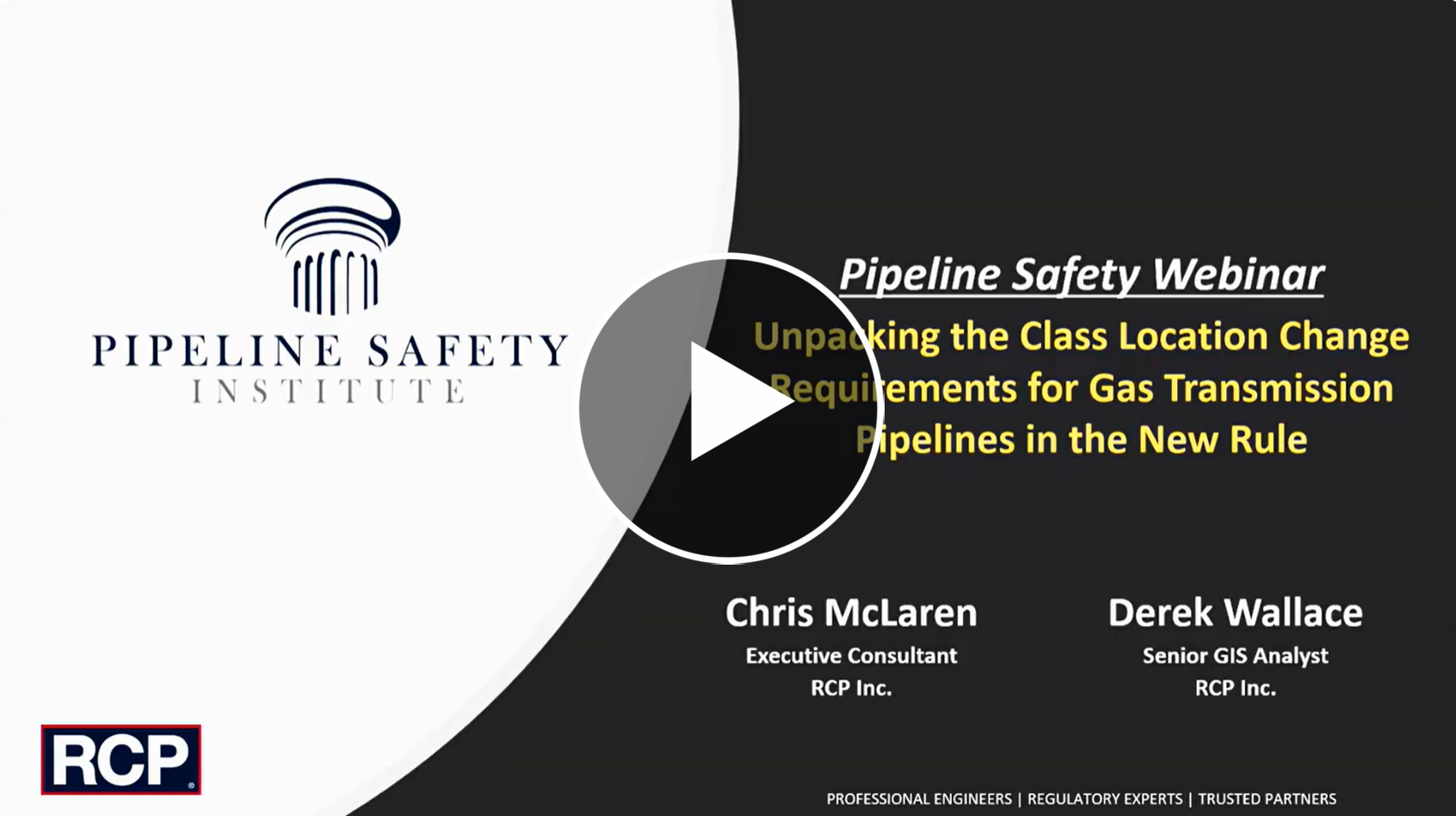
WEBINAR RECORDING
Pipeline Safety: Unpacking the Class Location Change Requirements
Pipeline Safety: Unpacking the Class Location Change Requirements
Thank you to everyone who attended and participated in this informative webinar. The session recording is posted to our YouTube channel. Please watch, like, and subscribe to our channel!
You asked and we listened!
Advanced DOT Pipeline Compliance Workshop is on the calendar!
This intensive and interactive 3-day, in-person workshop is designed for those who have previously completed our DOT Pipeline Compliance Workshop and are ready to take their knowledge to the next level.
New Workshop Alert!
Prepare Your Team for Pipeline Safety Audits with Confidence!
Our 3-day Pipeline Safety Audit Workshop is tailored for professionals responsible for the safe operation of hazardous liquid and natural gas pipelines. Designed for groups of 10-15 participants, this interactive training…
On-Site Training Request
We have conducted on-site training for oil and gas companies for over 25 years and can provide customized workshops for companies with groups of five or more.
We would welcome the opportunity to discuss our services with you.
Sincerely,

W. R. (Bill) Byrd, PE
President
RCP Inc.
- DOT Pipeline Compliance Workshop – February 25 & 26, 2009
- New Jersey Damage Prevention Regulations – Proposed Changes
- PHMSA Final Rule: Polyamide-11 (PA-11) Plastic Pipe Design Pressures
- New NPMS Data Submission Guidelines
- SPCC Revision Highlights
- New Drill Rules for Gas Wells in Texas
- Technical Advisory Committee Meetings for DIMP and CRM
- API Public Awareness Workshop
- API Pipeline Conference and Safety, Environmental, and Distinguished Award Program
- Regulatory Watch: Key Dates & Deadlines
- Conference News
- PSI Training Schedule