Proposed Updates to Pipeline and Liquefied Natural Gas Reporting Requirements RIN 2137-AE33

[Docket No. PHMSA-2008-0291]

PHMSA has issued a Notice of Proposed Rulemaking (NPRM) which seeks to update the reporting requirements for operators of natural gas pipelines, hazardous liquid pipelines, and liquefied natural gas (LNG) facilities. Highlights of the proposed changes include the following:

  • Modify the scope of part 191 to reflect previous regulatory changes made for the definition of gas gathering lines.
  • Change the definition of a gas pipeline “incident” to require an operator to report an explosion or fire not intentionally set by the operator. The proposal also establishes a volumetric basis of 3,000 MCF for reporting unexpected or unintentional gas loss.
  • Require all pipeline and LNG operators to submit reports electronically unless the operator can demonstrate this creates undue burden and hardship.
  • Require operators of LNG facilities to submit incident and annual reports, similar to hazardous liquid and gas pipeline operators.
  • Create a new pipeline facility identification registry designed to eliminate the existing problems associated with the current Operator Identification (OPID) data. PHMSA will require all regulated pipeline and LNG operators to obtain Operator Identification (OPID) numbers, and require all existing operators to re-apply for OPID numbers, even if these OPID numbers already exist. Also, PHMSA will require notice for new transmission pipeline construction greater than 10 miles or project costs greater than $5 million. Certain changes to pipeline and LNG facilities will require 60 days notice, including changes in operating entity, acquisition or divestiture of 50 or more miles of existing pipeline facilities, and any modification to existing pipeline facilities costing $5 million or more,
  • Require operators to use a new standardized form and electronically submit Safety-Related Condition Reports and Offshore Pipeline Condition Reports.
  • Revise the annual reporting requirements for gas transmission pipeline operators. This will include merging the Semi-Annual Performance Measures Report with the gas transmission annual report. In doing so, the Semi-Annual Performance Measures Report will be eliminated while the annual report will include the equivalent data. Several other changes will be made to the gas transmission annual report, including: revised leak cause categories to include those listed in ASME B31.8S, add information for miles of gathering lines by Type A and Type B gathering; class location information by SMYS, volume of commodity transported, and type of commodity transported.
  • Modify hazardous liquid operator telephonic notification of accidents to require operators to have and use a procedure to calculate and report a reasonable initial estimate of released product and to provide an additional telephonic report to the National Response Center if significant new information becomes available during the emergency response phase.
  • Revise the existing hazardous liquid annual report data requirements to include this information on a state-by-state basis for each state in with their pipelines traverse. This includes basic infrastructure data as well as integrity management data that is granulated down to a state-by-state basis.
  • Remove obsolete provisions that would conflict with the proposal to require electronic submission of all reports.
  • Update OMB control numbers assigned to information collections.

Comments should reference Docket No. PHMSA-2008-0291 and be submitted by August 31, 2009. To request a copy of the NPRM, contact Jessica Roger.

PHMSA R&D; Forum Presentations

PHMSA held its R&D; Forum on June 24-25th in Washington DC. Several breakout sessions were held during this forum which is intended to identify and prioritize funding for future pipeline safety research projects. The presentations can be found here. Presentations were made from stakeholders across the pipeline spectrum, including federal and state pipeline safety regulators, national standards organizations, offshore, new construction, hazardous liquids, gas transmission and distribution, and others. Some presentations have not yet been posted, but will be as they become available to PHMSA.

Yet one more SPCC Compliance Date Notice, and a Zinger!

[EPA-HQ-OPA-2008-0546; FRL-8919-9, RIN 2050-AG49]

The Environmental Protection Agency (EPA) has amended the dates by which facilities must prepare or amend their Spill Prevention, Control, and Countermeasure (SPCC) Plans, and implement those Plans to November 10, 2010. Under the amended §112.3(a):

  • the owner or operator of a facility that was in operation on or before August 16, 2002, must maintain his SPCC Plan, make any necessary amendments to the Plan and fully implement it by November 10, 2010
  • while the owner or operator of a facility that came into operation after August 16, 2002, but before November 10, 2010, is required to prepare and implement an SPCC Plan on or before November 10, 2010.
  • Under the amended §112.3(b)(1), the owner or operator of an onshore or offshore facility that becomes operational after November 10, 2010, and could reasonably be expected to have a discharge as described in § 112.1(b), must prepare and implement a Plan before beginning operations.

Under amended §112.3(c), an owner or operator of a mobile facility is required to maintain his SPCC Plan, but must make any necessary amendments and implement it on or before November 10, 2010. The owner or operator of an onshore or offshore mobile facility that becomes operational after November 10, 2010, and could reasonably be expected to have a discharge as described in §112.1(b), must prepare and implement an SPCC Plan before beginning operations.

The Agency believes that an extension of the compliance date is appropriate because it provides the owner or operator of a facility the opportunity to f ully understand all of the regulatory amendments offered by revisions to the SPCC rule promulgated since July 2002. This extension will allow the regulated community approximately 16 months beyond the previous compliance date of July 1, 2009 to make changes to their facilities and to their SPCC Plans necessary to comply with the revised SPCC requirements.

Editor’s Note: Here comes the zinger!

Furthermore, because EPA has not yet decided how to proceed on the December 2008 rule amendments, the Agency believes that this compliance date extension provides sufficient time for the Agency to review those comments and to promulgate any additional revisions that result from this review. The Agency expects to promulgate final revisions to the December 5, 2008 amendments, if any, in November of 2009 and is therefore choosing a compliance date that is approximately one year from the expected publication date of those revisions.

Editor’s Translation: “We extended the deadlines to give us time to figure out what we REALLY are going to require you to do. We’ll let you know in November. Until then, just keep maintaining the plans you have.”

What does it mean when RCP says they are

“Professional Engineers”?

We do a lot of consulting, and are proud of our accomplishments in that area . . . but as they say, all you need to do in order to be a “consultant” is to call yourself one. Being a professional engineer, on the other hand, is strictly regulated and requires demonstration of technical expertise and experience. RCP’s tag line is “Professional Engineers. Regulatory Experts. Trusted Partners.” We couldn’t say the “Professional Engineers” part unless it was true and it is. While RCP is best known for its expertise with regulations and regulatory compliance, we also provide excellent engineering services including integrity management, risk assessment, and expert witness testimony. Our employees do the nitty-gritty engineering analysis to evaluate mechanical integrity issues, develop remediation programs, and coordinate repair and replacement programs. At the same time, they are demonstrated experts in regulatory compliance issues and management. There just isn’t another company that provides RCP’s unique mixture of regulatory expertise and real-world engineering and implementation experience.

What does that mean to you? RCP can provide a broad range of integrity management, compliance management, and process safety management services to your company – increasing your quality of service while decreasing your overall costs and simplifying your contract administration. If you haven’t asked, you’ll never know what problems we could solve for you!

Proposed Rule: Safety and Environmental Management Systems for Outer Continental Shelf Oil and Gas Operations

[Docket ID MMS-2008-OMM-0003]

The Minerals Management Service (MMS) proposes to require operators to develop and implement a Safety and Environmental Management System to address oil and gas operations in the Outer Continental Shelf. The Safety and Environmental Management System would consist of four elements that, until now, have not been covered in our regulations:

  • Hazards Analysis,
  • Management of Change,
  • Operating Procedures, and
  • Mechanical Integrity

The MMS analyzed accident panel investigation reports, incident reports, and incidents of noncompliance and determined that the root cause of most safety and environmental accidents and incidents is one or more of these four elements. The MMS believes that requiring operators to implement a Safety and Environmental Management System will reduce the risk and number of accidents, injuries, and spills during Outer Continental Shelf activities.

The proposed rule would apply to pipelines regulated by the MMS, as well as to other types of production facilities.

Comments on the proposed rule are due by September 15, 2009. Please use the Regulation Identifier Number (RIN) 1010-AD15 as an identifier in your message.

For questions on technical issues contact David Nedorostek, Safety and Enforcement Branch at david.nedorostek@mms.gov or (703) 787-1029.

Save the Dates!

If you were unable to attend our June 2 & 3 workshop, the next workshop will be held on

October 6 & 7 (Tuesday & Wednesday) – Houston, TX

Visit our Seminars webpage for updates & registration information.

RRC Increase in Service Line Assessment Fees

TRRC Increase in Service Line Assessment Fees

The Texas Railroad Commission (TRRC) proposes to amend §8.201(b) to increase the assessment rate from $0.50 to $0.70 annually for each service line reported to be in service at the end of each calendar year in order meet the requirements of the pipeline safety program. The proposed increase of this fee to $0.70 will fund the Commission's hiring of additional personnel within the Safety Division. Federal funding for the pipeline safety program is tied to the Commission's staffing levels and the Commission's program has been adversely affected by under-staffing. The Commission will use the additional funds to add 11.5 new full-time equivalent employees (FTEs) for the pipeline safety program.

The pipeline safety inspection fee was created in 2003 to support the pipeline safety program, which is funded partially by federal funds; the remainder is funded by state general revenue dollars. The fee was originally set in 2003, at $0.37 annually for each service line reported by a natural gas distribution system; in 2007, the fee was increased to $0.50.

The effective date of Senate Bill 1658 and of this proposed rule amendment will be September 1, 2009.

Gas Distribution Leak Management System

Do you know what leak surveys are pending in the next 30 days and which ones are overdue?

Do you know exactly how many and what type of leaks are active on your system?

Do you know what leaks are scheduled for repair or re-survey next week?

Do you have a tool that manages and analyzes the data you will need for DIMP implementation?

Does your GIS system maintain survey, leak & repair history attributes?

How long will it take you to aggregate the leak data for the DOT Annual Report or Texas PS-95?

If you are interested in a tool that can give you the answers to these questions, contact Jessica Roger to schedule an online demonstration.

Kansas Pipeline Safety Regulations – Modifications

The State of Kansas has modified their pipeline safety regulations found in Kansas State Regulations; Agency 82 – Corporation Commission; Article 11 – Natural Gas Pipeline Safety. The modifications include changes to the requirements for gas pipeline leak detection, monitoring, and repair; and for cast iron pipe sampling and replacement. Changes were also made to the drug and alcohol requirements. Note that the Kansas Pipeline Safety Regulations are only applicable to intra-state gas pipelines in Kansas.

Ongoing Resources

These articles are maintained and updated as new information becomes available.

Last Updated: October 2026

Regulatory Watch: Key Dates & Deadlines

Welcome to Regulatory Watch! In this monthly update, we’ll keep you informed on proposed rule comment periods, effective dates, and upcoming deadlines for various compliance requirements.

Proposed Rule Stage

2137-AF37Proposed Rule Stage

Oil Spill Response Plans, Accident Notifications, Inspections and Investigations and other Miscellaneous Pipeline Safety Changes

2137-AF52Proposed Rule Stage

Pipeline Operational Status

2137-AF60Proposed Rule Stage

Safety of Carbon Dioxide and Hazardous Liquid Pipelines

Final Rule Stage

2137-AF53Final Rule Stage

Safety of Gas Distribution Pipelines and Other Pipeline Safety Initiatives

Sprint I & II Update

To further the Administration’s deregulatory policies, PHMSA has published in today’s Federal Register twenty-eight (28) separate rulemaking actions affecting the pipeline safety regulations (PSR; Parts 190-199). Click here to access the documents.

Rulemaking Description Stage Code
Pipeline Safety: Rationalize Special Permit Conditions PHMSA proposes to amend its special permit procedures to ensure permit conditions are directly tied to the specific pipeline safety regulations being waived. NPRM 49 CFR Part 190
Pipeline Safety: Rationalize Calculation of Regulatory Filing and Compliance Deadlines PHMSA will clarify that regulatory filing and compliance deadlines falling on weekends or Federal holidays automatically move to the next business day. DFR 49 CFR Part 190
Pipeline Safety: Adjust Annual Report Filing Timelines PHMSA will amend annual reporting requirements to move the gas pipeline annual report submission deadline from March to June. DFR 49 CFR Part 191
Pipeline Safety: Property Damage Definition for Incident Reporting PHMSA will clarify incident reporting property damage calculations for gas pipelines and update hazardous liquid accident reporting thresholds using inflation-adjusted criteria. DFR 49 CFR Parts 191 & 195
Pipeline Safety: Exception for In-Plant Piping Systems PHMSA proposes to clarify that in-plant piping systems are not subject to federal pipeline safety regulations. NPRM 49 CFR Part 192
Pipeline Safety: Codify Enforcement Discretion on Incidental Gathering Lines PHMSA proposes to codify enforcement discretion clarifying that restrictions on the historical incidental gathering line exemption apply only to newly constructed lines. NPRM 49 CFR Part 192
Pipeline Safety: Eliminate Burdensome Coating Assessment Deadlines PHMSA proposes to replace prescriptive deadlines for coating damage assessments and remediation with a requirement that activities be completed before the pipeline is placed in service. NPRM 49 CFR Part 192
Pipeline Safety: Atmospheric Corrosion Reassessment for Pipeline Replacements PHMSA proposes to remove the 3-year reassessment interval following replacement of atmospheric corrosion defects and allow use of the standard 5-year reassessment interval. NPRM 49 CFR Part 192
Pipeline Safety: Harmonize Class Change Pressure Test Requirements PHMSA proposes to reduce the minimum pressure test duration following certain class location changes from 8 hours to 4 hours, aligning with existing Subpart J requirements. NPRM 49 CFR Part 192
Pipeline Safety: Clarify MAOP Reconfirmation Testing Records PHMSA will issue a technical correction clarifying that operators may use pre-1970s pressure test records when reconfirming MAOP under §192.624. Final Rule 49 CFR Part 192
Pipeline Safety: Remote Sensing Technologies for ROW Patrols PHMSA will explicitly allow right-of-way patrols to be conducted using unmanned aircraft systems, satellites, and other remote sensing technologies. DFR 49 CFR Parts 192 & 195
Pipeline Safety: Technical Standards Updates and Amendments PHMSA will update incorporated standards and make technical amendments in response to an industry petition for reconsideration. Final Rule 49 CFR Part 192
Pipeline Safety Program: Update of Standards Incorporated by Reference PHMSA issued multiple direct final rules updating incorporated industry consensus standards used throughout Parts 192 and 195, replacing outdated editions with current versions. Multiple DFRs 49 CFR Parts 192 & 195

The following is a summary of the 40 rulemakings that PHMSA published in the Federal Register on April 24, 2026. If any adverse comment is received to a DFR PHMSA must rescind the rule and repropose. Click here to access the documents.

Rulemaking Description Stage Code
Pipeline Safety and Hazardous Materials Safety: Amendments to PHMSA Procedural Regulations PHMSA proposed miscellaneous amendments to procedural regulations governing informal rulemaking for both pipeline safety and hazardous materials programs. NPRM 49 CFR Part 190
Pipeline Safety: Interpretation Request Procedures PHMSA amended interpretation procedures to require publication of interpretation requests on its website and provide an opportunity for public comment. Final Rule 49 CFR Part 190
Pipeline Safety: Declaratory Order Procedures PHMSA established formal procedures for issuing declaratory orders through a new section in Part 190. Final Rule 49 CFR Part 190
Pipeline Safety: Consent Orders PHMSA clarified that consent agreements may be used to resolve enforcement actions, including cases involving civil penalties. Final Rule 49 CFR Part 190
Pipeline Safety: Adjustment to OPID Notifications for Construction PHMSA proposed adjusting the inflation-based threshold that triggers OPID notifications for certain construction and facility modification activities. NPRM 49 CFR Part 191
Pipeline Safety: Eliminating Limitations on Welders and Welding Operators PHMSA proposed allowing welders qualified through non-destructive testing methods to perform compressor station welding activities currently subject to additional restrictions. NPRM 49 CFR Part 192
Pipeline Safety: Material Properties Verification During MAOP Reconfirmation PHMSA proposed clarifying that material testing at pressure test manifold sites is not required when traceable, verifiable, and complete material records already exist. NPRM 49 CFR Part 192
Pipeline Safety: Electronic Retention of Part 194 Response Plans PHMSA amended regulations to allow operators to maintain electronic copies of response plans instead of paper copies. DFR 49 CFR Part 194
Pipeline Safety: Remote Monitoring of Rectifiers PHMSA proposed allowing remote monitoring technologies for rectifiers used in external corrosion control programs. NPRM 49 CFR Part 195
Pipeline Safety: Clarifying Hazardous Liquid High-Consequence Area Designations PHMSA amended HCA guidance to clarify spill considerations in agricultural fields and reorganize threat identification guidance. DFR 49 CFR Part 195
Pipeline Safety: Timeframe to Make Rupture-Mitigation Valves Operational PHMSA proposed extending the deadline for placing rupture-mitigation valves into operation from 14 days to 90 days after a pipeline enters service. NPRM 49 CFR Part 192
Pipeline Safety: Hazardous Liquid Valve Maintenance Schedule PHMSA proposed allowing operators to implement risk-based valve maintenance schedules, subject to a maximum inspection interval of one year. NPRM 49 CFR Part 195
Pipeline Safety: Property Damage Definition for Incident Reporting PHMSA proposes revising property damage thresholds for reportable gas and hazardous liquid pipeline incidents and clarifying applicability to telephonic notifications. NPRM 49 CFR Parts 192 & 195
Pipeline Safety: Remote Sensing Technologies for ROW Patrols PHMSA proposes clarifying that unmanned aerial systems, satellites, and other remote-sensing technologies may be used to satisfy right-of-way patrol requirements. NPRM 49 CFR Parts 192 & 195
Pipeline Safety: Adjust Annual Report and NPMS Filing Timelines PHMSA proposes extending annual report and NPMS submission deadlines for gas pipeline and storage operators to June 15 each year. NPRM 49 CFR Part 191
Pipeline Safety: Editorial Corrections and Clarifications PHMSA issued multiple final rules correcting editorial errors, updating references, removing obsolete submission methods, and improving regulatory clarity. Final Rules Various
Pipeline Safety: Update of Standards Incorporated by Reference PHMSA issued multiple direct final rules updating incorporated industry consensus standards, including NFPA, ASTM, MSS, NACE, and ASME standards. Multiple DFRs 49 CFR Parts 192 & 195

Have questions about an upcoming deadline? Please reach out to Jessica Foley for assistance!

Last Updated: October 2026

Conference News

Jan252027

Pipeline Pigging and Integrity Management Conference

▦ January 25, 2027 – January 28, 2027⌖ George R. Brown Convention Center, Houston, TX

The 39th International Pipeline Pigging & Integrity Management Conference (PPIM) will take place at the George R. Brown Convention Center in Houston. The event brings together pipeline operators, engineers, and industry professionals to explore advancements in pipeline inspection, integrity management, risk assessment, and emerging technologies.…

ExhibitingBooth 524
RCP Team Attending
Heather RoarkHeather RoarkSales & Marketing Coordinator

Jessica FoleyJessica FoleyVice President
Featured Presentations
Chris McLaren
Chris McLarenExecutive Consultant
October 27, 2026 at 7:30 AM
Event Details
Last Updated: October 2026

PSI Training Schedule

Date Training Course Price Registration
Nov 17 – Nov 19, 2026 DOT Pipeline Compliance Workshop $2,150 SOLD OUT
Feb 16 – Feb 18, 2027 Pipeline Safety Audit Training $2,150 Register →
Feb 23 – Feb 25, 2027 Advanced Pipeline Risk Assessment Workshop $2,150 Register →
Mar 23 – Mar 25, 2027 DOT Pipeline Compliance Workshop $2,150 Register →

WEBINAR RECORDING!
Unpacking the Key Updates in API RP 1170 & 1171, 2nd Edition

RCP and the Pipeline Safety Institute offered a free webinar exploring the 2nd Editions of API RP 1170, Design and Operation of Solution-mined Salt Caverns Used for Natural Gas Storage and API RP 1171, Functional Integrity of Natural Gas Storage in Depleted Hydrocarbon Reservoirs and Aquifer Reservoirs. Thank you to everyone who attended and participated in this informative webinar. The session recording is posted to our YouTube channel. Please watch, like, and subscribe to our channel!

WEBINAR RECORDING
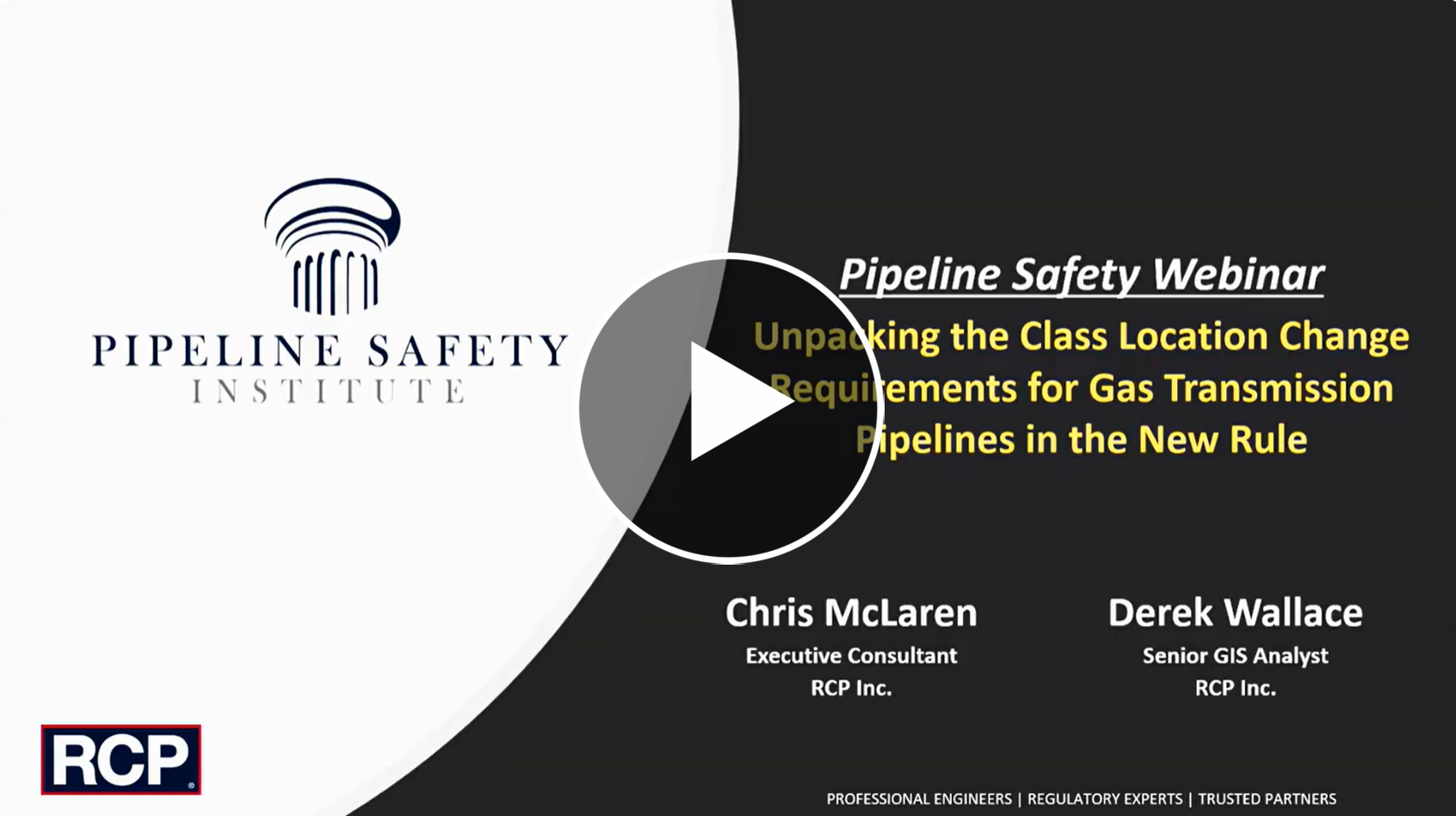
Pipeline Safety: Unpacking the Class Location Change Requirements

Thank you to everyone who attended and participated in this informative webinar. The session recording is posted to our YouTube channel. Please watch, like, and subscribe to our channel!
You asked and we listened!

Advanced DOT Pipeline Compliance Workshop is on the calendar!

This intensive and interactive 3-day, in-person workshop is designed for those who have previously completed our DOT Pipeline Compliance Workshop and are ready to take their knowledge to the next level.

New Workshop Alert!

Prepare Your Team for Pipeline Safety Audits with Confidence!

Our 3-day Pipeline Safety Audit Workshop is tailored for professionals responsible for the safe operation of hazardous liquid and natural gas pipelines. Designed for groups of 10-15 participants, this interactive training…

On-Site Training Request

We have conducted on-site training for oil and gas companies for over 25 years and can provide customized workshops for companies with groups of five or more.

We would welcome the opportunity to discuss our services with you.

Sincerely,

W. R. (Bill) Byrd, PE
President
RCP Inc.