
- DOT Pipeline Compliance Workshop – October 19 – 21, 2010
- Periodic Updates of Regulatory References to Technical Standards and Miscellaneous Edits
- PHMSA Notice & Request for Comments on Information Collection Activities
- Technical Advisory Committee Meetings
- TSA Pipeline Security Guidelines – Information Collection Request Comment Period
- API Safety Standards Available Online
- Mary McDaniel moving to PHMSA
- Texas Railroad Commission Proposed New Rule Chapter 8 – Pipeline Safety Regulations relating to Distribution Facilities Replacements
- Texas Railroad Commission Adopts New Rules
- Texas Railroad Commission (TRRC) Damage Prevention Meeting
- Vessel and Facility Response Plans for Oil: 2003 Removal Equipment Requirements and Alternative Technology Revisions
- Procedures for Transportation Workplace Drug and Alcohol Testing Programs
- PHMSA Advisory Bulletin ADB-10-07
- Texas Railroad Commission Adopts Repeal & New §3.15 Surface Equipment Removal Requirements and Inactive Wells
- Revision of LNG and LHG Waterfront Facility General Requirements
- NESHAPs for SI RICE
- Regulatory Watch: Key Dates & Deadlines
- Conference News
- PSI Training Schedule
DOT Pipeline Compliance Workshop – October 19 – 21, 2010
Join us October 19 – 21 in Houston at our new office and dedicated training facility for an informative, lively, and interactive workshop on DOT Pipeline Compliance and OPA Planning for DOT Pipelines. This workshop has been attended by hundreds of pipeline personnel, with excellent feedback. The workshop provides an overview of the DOT pipeline regulations, and is appropriate for people who are new to pipeline regulations, who could use a refresher, or anyone who needs to know the latest information in these areas.
PROGRAM SCHEDULE:
Day 1 (October 19): Gas Pipeline Regulations (49CFR192)
The workshop will include an introduction to DOT/OPS pipeline compliance; State and Federal program variations; roles and responsibilities; design, construction, operations, maintenance, and emergency response requirements; how to monitor rulemaking activity and stay current with your compliance program; operator qualification, public awareness; with a specific emphasis on the gas integrity management regulations. Each attendee will receive general training materials which include the applicable DOT 49 CFR 192 regulations for gas pipelines (cd-rom), inspection checklists, and speaker's PowerPoint presentation handouts.
Day 2 (October 20): Special Topics
Back by popular demand! RCP is conducting a special workshop day to discuss topics that many of our clients have expressed an interest in:
- Control Room Management
- PHMSA reporting requirements and enforcement activities
- DIMP implementation strategies
- Public Awareness effectiveness evaluation & updates to RP 1162
- Crude oil gathering & low stress liquid lines regulatory developments
- Oil spill response plan developments
Each attendee will receive general training materials and speaker's PowerPoint presentation handouts.
Day 3 (October 21): Liquid Pipeline Regulations (49CFR195)
The workshop will include an introduction to DOT/OPS pipeline compliance; State and Federal program variations, roles and responsibilities; design, construction, operations, maintenance, and emergency response requirements; spill response planning requirements; how to monitor rulemaking activity and stay current with your compliance program; operator qualification and public awareness. Each attendee will receive general training materials which include the applicable DOT 49 CFR 195 regulations for hazardous liquid pipelines (cd-rom), inspection checklists, and speaker's PowerPoint presentation handouts.
To register, or for additional information, click here.
Periodic Updates of Regulatory References to Technical Standards and Miscellaneous Edits
RIN 2137-AE41
PHMSA has amended the Federal pipeline safety regulations to incorporate by reference all or parts of 40 new editions of voluntary consensus technical standards. This action allows pipeline operators to use current technologies, improved materials, and updated industry and management practices. Additionally, PHMSA has clarified certain regulatory provisions and made several editorial corrections. These amendments do not require pipeline operators to take on any significant new pipeline safety initiatives. The effective date of this final rule is October 1, 2010.
Editor’s note: I’m reminded of the military saying “Amateurs talk about strategy. Professionals talk about logistics.” In this case, the professionals talk about incorporated standards. The following information is lengthy and tedious, but it is important.
Misc. Issues:
There is an ongoing controversy concerning the primacy of NFPA 58 and 59 versus 49 CFR 192 requirements. PHMSA will address the subject of NFPA 58 and 59 primacy under a separate rulemaking. In the interim, compliance with part 192 requirements has not changed. When a requirement exists in part 192 that does not exist in NFPA 58 or 59, operators are required to comply with it. A conflict only exists when an operator cannot comply with a requirement in NFPA 58 and 59 because it conflicts with a requirement in part 192. When a conflict exists, NFPA 58 or 59 continue to prevail. PHMSA is not changing the editions currently incorporated by reference (2004 editions of NFPA 58 and 59).
PHMSA is incorporating only those sections of NFPA 59A, “Standard for the Production, Storage, and Handling of Liquefied Natural Gas (LNG)” (2006 edition) relating to ultrasonic inspection and seismic design requirements. Except for the specified sections in the 2006 edition mentioned above, PHMSA will continue to reference NFPA 59A (2001 edition).
PHMSA will not incorporate by reference ASTM D2513: Standard Specification for Thermoplastic Gas Pressure Pipe, Tubing and Fittings (2007) edition at this time but will continue to reference the 1987 & 1999 editions.
PHMSA will consider a Stay of Enforcement from Section A.1.5.7 in the 1999 edition of ASTM D2513 to recognize the safe, longer storage time of PE pipe separate from this rulemaking.
Deleting Old Standards:
In a Direct Final Rule (74 FR 17099) published on April 14, 2009, PHMSA incorporated by reference the 2007 editions of ANSI/API Specification 5L, “Specification for Line Pipe” and API Standard 1104, “Welding of Pipelines and Related Facilities.” However, it did not eliminate the use of the previously referenced editions of these standards. PHMSA has now eliminated the use of the previous editions of these standards [ANSI/API Specification 5L/ISO 3183, “Specification for Line Pipe” 43rd edition and errata, 2004 and API Standard 1104 (19th edition, 1999, including errata October 31, 2001)].
New Standards:
PHMSA is incorporating by reference API Recommended Practice 5L1/ISO 3183 “Specification for Line Pipe” (6th edition, 2002) into the newly-created § 195.207. This standard provides a standard for hazardous liquid operators for the transportation of certain API Specification 5L steel line pipe by railroad.
PHMSA is also incorporating API Recommended Practice 5LW (API RP 5LW), “Transportation of Line Pipe on Barges and Marine Vessels” (2nd edition, 1996) into Parts 192 and 195. This standard is referenced in § 192.65(a) and in the newly-created § 195.207(a). API RP 5LW provides a standard for transportation of certain API Specification 5L steel line pipe by ship or barge on both inland and marine waterways.
Replacement of old standards:
The following updated standards are replacing the previously incorporated editions:
- API Specification 6D/ISO 14313, “Specification for Pipeline Valves” 23rd edition (April 2008, effective October 1, 2008) and errata 3 (includes 1 & 2, February 2009), replaces the 22nd edition, January 2002.
- API Specification 12F, “Specification for Shop Welded Tanks for Storage of Production Liquids (11th edition, November 1, 1994, reaffirmed 2000, errata, February 2007), replaces the 11th edition, 1994 (reaffirmed, 2000);
- API Standard 510, “Pressure Vessel Inspection Code: In-Service Inspection, Rating, Repair, and Alteration” (9th edition, June 2006), replaces the 8th edition, 1997 including Addenda 1 through 4;
- API Standard 620, “Design and Construction of Large, Welded, Low-Pressure Storage Tanks,” (11th edition February 2008, addendum 1, March 2009), replaces the 10th edition, 2002 including addendum 1;
- API Standard 650, “Welded Steel Tanks for Oil Storage” (11th edition, June 2007, addendum 1, November 2008), replaces the 10th edition, 1998 including Addenda 1-3;
- ANSI/API Recommended Practice 651, “Cathodic Protection of Aboveground Petroleum Storage Tanks” (3rd edition, January 2007), replaces the 2nd edition, December 1997;
- ANSI/API Recommended Practice 652, “Linings of Aboveground Petroleum Storage Tank Bottoms” (3rd edition, October 2005), replaces the 2nd edition, December 1997
- API Standard 653, “Tank Inspection, Repair, Alteration, and Reconstruction” (3rd edition, December 2001, includes addendum 1 (September 2003), addendum 2 (November 2005), addendum 3 (February 2008), and errata (April 2008), replaces the 3rd edition, 2001 including addendum 1, 2003;
- API Standard 1104, “Welding of Pipelines and Related Facilities” (20th edition November 2005, errata/addendum (July 2007) and errata 2 (2008)), replaces IBR: 19th edition, 1999, including errata October 31, 2001;
- API Recommended Practice 1130, “Computational Pipeline Monitoring for Liquids Pipeline Segment” (3rd edition, September 2007), replaces the 2nd edition, 2002;
- API Standard 2000, “Venting Atmospheric and Low-Pressure Storage Tanks Nonrefrigerated and Refrigerated” (5th edition, April 1998, errata, November 15, 1999), replaces the 5th edition, April 1998;
- API Recommended Practice 2003, “Protection Against Ignitions Arising Out of Static, Lightning, and Stray Currents” (7th edition, January 2008), replaces the 6th edition, 1998;
- API Publication 2026, “Safe Access/Egress Involving Floating Roofs of Storage Tanks in Petroleum Service” (2nd edition, April 1998, reaffirmed, June 2006), replaces the 2nd edition, 1998;
- API Recommended Practice 2350, “Overfill Protection for Storage Tanks in Petroleum Facilities” (3rd edition, January 2005), replaces the 2nd edition, 1996;
- ASCE/SEI 7-05, “Minimum Design Loads for Buildings and Other Structures” (2005 edition, includes supplement number 1 and errata), replaces the 2002 edition;
- ASTM A53/A53M-07 (2007), “Standard Specification for Pipe, Steel, Black and Hot-Dipped, Zinc-Coated, Welded and Seamless” (September 1, 2007) replaces the 2004 edition;
- ASTM A106/A106M-08 (2008), “Standard Specification for Seamless Carbon Steel Pipe for High-Temperature Service” (July 15, 2008), replaces the 2004 edition;
- ASTM A372/A372M-03 (reapproved 2008), “Standard Specification for Carbon and Alloy Steel Forgings for Thin-Walled Pressure Vessels” (March 1, 2008) replaces the 2003 edition;
- ASTM A381-96 (Reapproved 2005), “Standard Specification for Metal-Arc-Welded Steel Pipe for Use with High-Pressure Transmission Systems” (October 1, 2005) replaces the 1996 edition; reapproved 2001;
- ASTM A671-06, “Standard Specification for Electric-Fusion-Welded Steel Pipe for Atmospheric and Lower Temperatures” (May 1, 2006) replaces the 2004 edition;
- ASTM A672-08, “Standard Specification for Electric-Fusion-Welded Steel Pipe for High-Pressure Service at Moderate Temperatures” (May 1, 2008) replaces the 1996 edition; reapproved 2001;
- ASTM A691-98 (reapproved 2007), “Standard Specification for Carbon and Alloy Steel Pipe, Electric-Fusion-Welded for High-Pressure Service at High Temperatures” (November 1, 2007) replaces the 1998 edition, reapproved 2002;
- ANSI/ASME B16.1 -2005, “Gray Iron Pipe Flanges and Flanged Fittings: (Classes 25, 125, and 250)” (August 31, 2006) replaces ASME B16.1-1998 “Cast Iron Pipe Flanges and Flanged Fittings” 1998 edition;
- ANSI/ASME B16.9 -2007, “Factory-Made Wrought Butt Welding Fittings” (December 7, 2007) replaces IBR: 2003 edition (February 2004);
- ANSI/ASME B31.4 -2006, “Pipeline Transportation Systems for Liquid Hydrocarbons and Other Liquids” (October 20, 2006) replaces IBR: 2002 edition (October 2002);
- ANSI/ASME B31.8 -2007, “Gas Transmission and Distribution Piping Systems” (November 30, 2007) replaces IBR: 2003 edition (February 2004);
- 2007 ASME Boiler & Pressure Vessel Code, Section I: Rules for Construction of Power Boilers (2007 edition, July 1, 2007) replaces IBR: 2004 edition, including addenda through July 1, 2005;
- 2007 ASME Boiler & Pressure Vessel Code, Section VIII, Division 1: Rules for Construction of Pressure Vessels (2007 edition, July 1, 2007) replaces IBR: 2004 edition, including addenda through July 1, 2005;
- 2007 ASME Boiler & Pressure Vessel Code, Section VIII, Division 2: Alternative Rules, Rules for Construction of Pressure Vessels (2007 edition, July 1, 2007) replaces IBR: 2004 edition, including addenda through July 1, 2005;
- 2007 ASME Boiler & Pressure Vessel Code, Section IX: Qualification Standard for Welding and Brazing Procedures, Welders, Brazers, and Welding and Brazing Operators (2007 edition, July 1, 2007) replaces IBR: 2004 edition, including addenda through July 1, 2005;
- GTI-04/0032 LNGFIRE3: A Thermal Radiation Model for LNG Fires (March 2004) replaces IBR: GRI-89/0176 “LNGFIRE: A Thermal Radiation Model for LNG Fires” (June 29, 1990); (Note: This is just a title change. The model has not been changed).
- MSS SP-44-2006, Standard Practice, “Steel Pipeline Flanges” (2006 edition) replaces IBR: 1996 edition reaffirmed 2001;
- NACE SP0169-2007, Standard Practice, “Control of External Corrosion on Underground or Submerged Metallic Piping Systems” (reaffirmed March 15, 2007) replaces NACE Standard RP0169-2002, “Control of External Corrosion on Underground or Submerged Metallic Piping Systems;”
- NACE SP0502-2008, Standard Practice “Pipeline External Corrosion Direct Assessment Methodology” (reaffirmed March 20, 2008) replaces NACE Standard RP0502-2002 “Pipeline External Corrosion Direct Assessment Methodology;”
- NFPA 30, “Flammable and Combustible Liquids Code” (2008 edition, approved August 15, 2007) replaces the 2003 edition;
- NFPA 59A, “Standard for the Production, Storage, and Handling of Liquefied Natural Gas (LNG) (2006 edition, approved August 18, 2005) partially replaces the 2001 edition;
- NFPA 70 (2008), “National Electrical Code” (NEC 2008) (Approved August 15, 2007) replaces the 2005 edition;
- PPI TR-3/2008 HDB/HDS/PDB/SDB/MRS Policies (2008),”Policies and Procedures for Developing Hydrostatic Design Basis (HDB), Pressure Design Basis (PDB), Strength Design Basis (SDB), and Minimum Required Strength (MRS) Ratings for Thermoplastic Piping Materials or Pipe” (May 2008) replaces the 2004 edition;
Misc. Rule Changes and Clarifications:
PHMSA has moved the definitions, “active corrosion,” “electrical survey” and “pipeline environment” from § 192.465(e) to § 192.3. This revision provides a broader applicability of these terms to part 192 because these terms are also found in part 192, subparts I and O.
PHMSA has revised paragraphs (d) and (e) of § 192.145 to use the same language as ANSI/ASME B31.8, paragraph 831.11(c) in referring to shell components. The revisions to paragraph (d) clarify the elements of a “shell component.”
PHMSA has also clarified the materials allowed in certain valve components used in compressor stations in response to the GPTC petition. Paragraph (e) clarifies that cast iron, malleable iron, or ductile iron may be used in the valve ball or plug, but may not be used in the pressure holding shell components (e.g., body, bonnet, cover, or end flange).
49 CFR § 192.711 has been modified to clarify that the repair times for pipelines covered by § 192.711 pertain only to non-integrity management repairs.
49 CFR § 193.2101 has been modified to incorporate by reference sections from the 2006 edition of NFPA 59A pertaining to the seismic design of stationary LNG storage tanks. Other sections from the 2001 edition of NFPA 59A continue to be incorporated by reference as designated in § 193.2013. Although NFPA 59A (2006) incorporates by reference the 1990 edition of API Standard 620 for seismic design PHMSA is instead incorporating by reference the most recent version of API Standard 620 (11th edition, addendum 1, 2009).
PHMSA has clarified the language in § 193.2321(a) to use the broader terminology for nondestructive testing, and revised § 193.2321(b) to incorporate the requirements in the 2006 edition of NFPA 59A’s for the ultrasonic examination of LNG tank welds for storage tanks with an internal design pressure at or below 15 psig.
PHMSA has modified § 195.401 to clarify that the requirement to repair a condition within a reasonable time period (unless an immediate hazard) only applies to conditions on pipelines that are not “integrity management repairs” (covered by § 195.452).
PHMSA has revised § 195.432 paragraph (b) to eliminate the reference to Section 4 of API Standard 653. All sections in API Standard 653 relating to inspection of in-service atmospheric and low-pressure steel aboveground breakout tanks are incorporated by reference.
PHMSA has also made other misc editorial changes throughout their regulations to align references to current documents and section numbers.
Standard Operating Procedure Updates
RCP has developed standard operating procedures for hundreds of pipeline operators ranging from gas transmission, hazardous liquids, gas distribution, reservoir and salt dome gas storage facilities, oil terminals, regulated onshore gathering and offshore oil & gas facilities. Our procedure development process goes well beyond the typical cookie-cutter generic templates that you can buy off the shelf. We have a strong track record with successful PHMSA and state inspection performance. Our procedure development process integrates with the daily operating processes that your personnel and contractors currently follow. When complete, you will have a comprehensive set of procedures that are easy to manage and comply with federal and state regulatory requirements. For more information, contact Jessica Roger.
PHMSA Notice & Request for Comments on Information Collection Activities
The Department of Transportation/Pipeline Hazardous Materials Safety Administration (PHMSA) invites comments on an information collection under Office of Management and Budget (OMB) Control No. 2137-0596, titled “National Pipeline Mapping Program.” PHMSA is preparing to request a three-year term of approval from OMB for a renewal of the current information collection.
Each operator of a pipeline facility (except distribution lines and gathering lines) must provide contact information and geospatial data on their pipeline system. This information should be updated on an annual basis. The provided information is incorporated into the National Pipeline Mapping System (NPMS) to support various regulatory programs, pipeline inspections, and authorized external customers. The periodic updates of operator pipeline data inform the NPMS of any changes to the data over the previous year and allow PHMSA to maintain and improve the accuracy of the information.
Comments can be submitted on the E-Gov Web Site on or before November 1, 2010. Reference Docket No. PHMSA-2010-0246.
Technical Advisory Committee Meetings
As mentioned in last month’s newsletter, PHMSA hosted a public meeting of the Technical Pipeline Safety Standards Committee (TPSSC) and of the Technical Hazardous Liquid Pipeline Safety Standards Committee (THLPSSC) on Thursday, August 19, 2010. PHMSA briefed the committees on several regulatory and policy initiatives including:
- Pipeline safety reauthorization
- PHMSA accomplishments (National Transportation Safety Board, General Accounting Office, Congressional mandates)
- PHMSA priorities (new construction, damage prevention), and the status of PHMSA rulemaking initiatives
- Administrative matters of the committee (charter, how we can best conduct business).
The meeting agenda and briefing papers below are available on the PHMSA website:
- Part 192/195 evaluation project
- Excess Flow Valves for larger applications
- Administrative matters of the committees
TSA Pipeline Security Guidelines – Information Collection Request Comment Period
The Department of Homeland Security (DHS) TSA Pipeline Security Division is requesting comments on its Information Collection Request (ICR) of pipeline security information. The ICR describes the nature of the information collection and responds to specific comments received to the TSA ICR published on July 29, 2009 at 74 FR 37723. The collection involves the submission of contact information for the company’s primary and alternate security manager; the telephone number of the security operations or control center; and data concerning pipeline security incidents. At AGA’s request, the TSA has amended the draft TSA Pipeline Security Guidelines to clarify “pipeline security incidents” to mean “incidents which are indicative of a deliberate attempt to disrupt pipeline operations or activities that could be precursors to such an attempt.”
Interested persons are invited to submit written comments on the proposed information collection to the Office of Information and Regulatory Affairs, Office of Management and Budget. Comments should be addressed to Desk Officer, Department of Homeland Security/TSA, and sent via electronic mail to oira_submission@omb.eop.gov. Send your comments by September 15, 2010.
RCP’s Web-Based Compliance Management Systems
RCP’s Compliance Management System (CMS) is an invaluable tool for managing all aspects of regulatory workflow. Some examples of how our clients are using the CMS include:
- O&M; Scheduling and Data Acquisition;
- Cathodic Protection Inspection and Data Management;
- One-Call Screening and Ticket Management;
- Repair / Replacement Programs;
- Operator Qualification Administration and Workflow Integration;
- Leak Life Cycle Management;
- Environmental, Health and Safety Compliance;
- Audit Action Item Tracking; and
- Customer Data Management.
DIMP Integration
For gas distribution operators looking for a powerful tool to implement DIMP, the RCP CMS integrates O&M; data captured from field personnel along with inherent system attributes to provide real-time risk analysis, performance reporting, as well as track additional and accelerated actions taken to mitigate risks.
Key Features
- GIS integrated workflow management
- Custom tailored e-mail notifications and reporting
- Runs on any web-enabled device, no software to download
- Powerful reporting and custom query functionality
- Multiple security and user privilege settings
- Document storage and control (ex. procedures, maps, images, and completion documentation)
- Automatic recurrence setting for routine tasks (example: leak surveys, CP surveys, etc.)
- Create work orders for unscheduled / unplanned activities (ex. release reporting)
To request a demonstration or to request more information, please contact Jessica Roger.
API Safety Standards Available Online
The American Petroleum Institute (API) is making publicly available online for the first time more than 160 safety standards. Once changes to the API Web site are complete, a total of 160 standards — some of which apply to other oil and gas activities, such as hydraulic fracturing and pipeline safety standards — will be available online. The standards will include all regulations that have been adopted by reference in federal regulations and all standards that relate to safety. API’s Public Awareness Standard for Pipeline Operators (API 1162) was already available to the public before this announcement.
These standards will be available as "read only" access. Hardcopies and printable versions will continue to be available for purchase.
For more information regarding this announcement, visit the API website.
Mary McDaniel moving to PHMSA
Mary McDaniel will join PHMSA as a Compliance Officer in PHP’s Office of Enforcement starting September 13, 2010. Mary is well known and respected by PHMSA personnel and the greater pipeline community. Mary retired, effective August 31, from her position of Director of the Pipeline Safety Division with the Railroad Commission of Texas, where she has been since 1983. In her role as Director, she was responsible for planning, developing, and implementing the State of Texas’ pipeline safety program. She has directed the work of 64 professional, technical, and administrative personnel in headquarters and eight regions. She has been a member of the National Association of Pipeline Safety Representatives and the NARUC Subcommittee on Pipeline Safety. Mary holds a Bachelor of Science Degree in Chemical Engineering from the University of Texas at Austin. She has a professional engineers license in Chemical Engineering in the State of Texas. We wish her well in her new position.
Texas Railroad Commission Proposed New Rule Chapter 8 – Pipeline Safety Regulations relating to Distribution Facilities Replacements
GUD Docket No. 9997
The Texas Railroad Commission (TRRC) authorized a proposed new rule §8.209 to be published for a 30-day public comment period to address mandatory replacement of steel service lines and other facilities in natural gas distribution systems. Highlights of the proposed new rule include:
- Proposed new subsection (a) states that, effective January 1, 2011, the new section applies to each operator of a gas distribution system that is subject to the requirements of 49 CFR Part 192. The section prescribes the minimum requirements by which all operators will develop and implement a risk-based program for the removal or replacement of distribution facilities, including steel service lines, in such gas distribution systems. Each operator’s risk-based program will be developed in conjunction with the recently adopted PHMSA regulations regarding integrity management for distribution operators. Operators will use the risk-based program to manage any risks identified through the risk-based analysis by developing a replacement program to remove those integrity related risks from the pipeline systems.
- Proposed new subsection (b) requires that each operator use welding or fusing to make all belowground joints wherever practical. Where joints involving polyethylene pipe are made by mechanical means, the joints must meet the requirements of ASTM D2513 and be designated as a Category 1 type joint. Non-welded joints on steel pipe must comply with the requirements of 49 CFR Part 192.273
- Proposed new subsection (c) directs that no later than March 1, 2011, each operator must establish and submit to the Pipeline Safety Division for review and approval the operator’s written procedures for implementing the requirements of this section. Each operator must develop a risk-based program that determines the relative risks and probable consequences associated with the operation of each pipeline system or segment.
- Proposed new subsection (d) requires each operator to use data collected under its distribution integrity management plan (DIMP) and PS-95 to determine the potential relative risks associated with each of the operator’s distribution systems by identifying pipeline segments or facilities for replacement.
- Proposed new subsection (f) applies to operators that determine under subsection (c) that steel service lines are the greatest risk, and requires such operators to use a prescriptive model under subsection (g) for steel service line replacement.
- Proposed new subsection (g) applies to operators that determine under subsection (c) that steel service lines are the greatest risk. Subsection (g) provides that for those steel service lines that must remain in service, each operator must determine if an integrity risk exists on the segment, and if so must replace the segment with steel as part of the integrity management plan.
- For Priority 1 segments, an operator must complete the removal or replacement of steel service lines by June 30, 2013, and for Priority 2 segments, an operator must remove or replace no less than 10% of the original inventory per year. For Priority 3 segments, an operator is not required to remove or replace any steel service lines; however, upon discovery of a leak on a steel service line, that line must be replaced rather than repaired, except where steel is the continued service line material.
The proposal should be published in the September 10, 2010, issue of the Texas Register. Comments on the proposal may be submitted to Rules Coordinator, Office of General Counsel, Railroad Commission of Texas, PO Box 12967, Austin, Texas 78711-2967; online; or by electronic mail.
TRRC will accept comments until noon (12:00 p.m.) on Tuesday, October 12, 2010, which is 31 days after publication in the Texas Register; comments should refer to GUD Docket No. 9997. For further information, call David Flores at (512) 463-7058. The status of TRRC rulemakings in progress is available at www.rrc.state.tx.us/rules/proposed.php. For a copy of the proposed new Chapter 8.209, contact Jessica Roger.
Texas Railroad Commission Adopts New Rules
The Texas Railroad Commission (TRRC) adopted two sets of rules. Both adopted rules have an effective date of August 30, 2010.
First, TRRC adopted amendments to §3.30, relating to the memorandum of understanding between the TRRC and the Texas Commission on Environmental Quality, with changes to the proposed version published in the April 9, 2010,issue of the Texas Register (35 TexReg 2817). See related story in the DOT Pipeline Compliance Newsletter May 2010 edition.
For a copy of the adopted amendments §3.30, contact Jessica Roger.
Second, TRRC adopted some amendments to various rules in Chapter 8 regarding federal updates, and liaison procedures pursuant to HB 4300, without changes to the versions published in the June 25, 2010, issue of the T exas Register (35 TexReg 5424). See related story in the DOT Pipeline Compliance Newsletter July 2010 edition. The amendments update federal provisions and citations, correct the name of the Safety Division to Pipeline Safety Division, and conform the rules to the statutory changes regarding community liaison activities enacted by House Bill 4300, 81st Legislative Session (Regular Session, 2009). Amendments to §§8.1, 8.5, 8.101, 8.130, 8.201, 8.235, 8.310, and 8.315, relating to:
- General Applicability and Standards;
- Definitions;
- Pipeline Integrity Assessment and Management Plans for Natural Gas and Hazardous Liquids Pipelines;
- Enforcement;
- Pipeline Safety Program Fees;
- Natural Gas Pipelines Public Education and Liaison;
- Hazardous Liquids and Carbon Dioxide Pipelines Public Education and Liaison; and
- Hazardous Liquids and Carbon Dioxide Pipelines or Pipeline Facilities Located Within 1,000 Feet of a Public School Building or Facility.
For a copy of the adopted amendments to Chapter 8, contact Jessica Roger.
Texas Railroad Commission (TRRC) Damage Prevention Meeting
On August 18, the TRRC held a meeting to hear ideas to improve the state code Chapter 18 Underground Pipeline Damage Prevention. The open meeting was attended by various stakeholders involved in the one call process, including utilities, municipalities, one call centers, utility contractors, locating contractors, and road builders. All were encouraged to express concerns with the language in the existing code and present suggestions to address the concerns. Specific issues which had the greatest discussion:
- Minimum depth of excavation activity which would necessitate a notification to the One Call Center;
- Structure of penalties when parties are found to be non-compliant with the code;
- An increase in the tolerance zone to reduce damages occurring due to mechanized equipment;
- Accuracy and timeliness of locates for underground facilities;
- Positive response from facility operator;
- Change in the time requirement to submit a damage report form to the Texas Commission;
- Conditions which might merit an emergency one call ticket;
- Maximum scope allowed in a single one call ticket; and
- Dialing 911 when a damage occurs to the pipeline
Editor’s note: I had to leave this meeting before it ended, and I stole this summary from Andrew Lu at AGA because he did such a great job of summarizing everything!
Vessel and Facility Response Plans for Oil: 2003 Removal Equipment Requirements and Alternative Technology Revisions
33 CFR Parts 154 and 155 [USCG-2001-8661]
On August 31, 2009, the Coast Guard published a final rule entitled "Vessel and Facility Response Plans for Oil: 2003 Removal Equipment Requirements and Alternative Technology Revisions" (74 FR 45004). This final rule amended its requirements for oil-spill removal equipment associated with vessel response plans and marine transportation-related facility response plans. The changes added requirements for new response technologies and revised methods and procedures for responding to oil spills upon the navigable waters of the United States, adjoining shorelines, and the exclusive economic zone. Those revisions triggered information collection requirements under 33 CFR 154.1065 and 155.1070. This provision requires that planholders show evidence that they have properly planned to mitigate oil outflow and to provide that information to the Coast Guard for its use in emergency response. This evidence includes name and contact information for oil spill responders for each vessel or facility with appropriate equipment and resources located in each zone of operation; specific lists of equipment that the resource providers will make available in case of an incident in each zone; and certification that the responders are qualified and have given permission to be included in the plan. Oil Spill Removal Organizations (OSROs) will also need to update contracts and their own records to add dispersant capabilities when appropriate. The Coast Guard will use this information to determine whether a vessel or facility meets the salvage and marine firefighting requirements.
With the exception of this collection of information, the Vessel and Facility Response Plans for Oil: 2003 Removal Equipment Requirements and Alternative Technology Revisions final rule became effective on September 30, 2009. As required by the Paperwork Reduction Act of 1995 (44 U.S.C. 3501-3520), the preamble to the final rule stated that the Coast Guard would not enforce the collection of information requirements occurring under 33 CFR 154.1065 and 155.1070 until the collection of information request was approved by OMB, and also stated that the Coast Guard would publish a notice in the Federal Register announcing that OMB approved and assigned a control number for the requirement. On August 20, 2010, OMB approved the collection of information and assigned the collection OMB Control Number 1625-0066 entitled "Vessel and Facility Response Plans (Domestic and Int'l), and Additional Response Requirements for Prince William Sound, Alaska".
Need to Update your Response Plan (FRP, ICP or OSRP)?
We have the expertise to update your Facility Response Plan, Integrated Contingency Plan, or Oil Spill Response Plan to include new guidance and lessons learned from recent incidents and natural disasters. Please contact Jessica Roger for more information.
Procedures for Transportation Workplace Drug and Alcohol Testing Programs
Effective October 1, 2010, the Department of Transportation (the Department or DOT) is amending certain provisions of its drug testing procedures dealing with laboratory testing of urine specimens. Some of the changes will also affect the training of and procedures used by Medical Review Officers. The changes are intended to create consistency with many, but not all, of the new requirements established by the U.S. Department of Health and Human Services. On November 25, 2008 (73 FR 7185), the U.S. Department of Health and Human Services (HHS) Substance Abuse and Mental Health Services Administration (SAMHSA) issued a Final Notice of Revisions to the HHS Mandatory Guidelines for Federal Workplace Drug Testing Programs (HHS Mandatory Guidelines) that included changes to the procedures for collection and testing of urine specimens, creation of and requirements for the certification of Instrumented Initial Test Facilities (IITFs), collection site oversight requirements, and changes to the role of and standards for collectors and Medical Review Officers (MROs). The HHS Mandatory Guidelines were to become effective May 1, 2010, but on April 30, 2010 (75 FR 22809), HHS postponed implementation until October 1, 2010. On February 4, 2010, DOT published a Notice of Proposed Rulemaking (NPRM) (75 FR 5722) seeking comments about changing part 40 to be consistent with certain aspects of the HHS Mandatory Guidelines. This final rule responds to the comments and makes a number of changes to the existing rules governing the Department's drug testing program.
For further information contact: Mark Snider, Senior Policy Advisor (S-1), Office of Drug and Alcohol Policy and Compliance, 1200 New Jersey Avenue, SE., Washington, DC 20590; telephone number 202-366-3784 (voice), 202-366-3897 (fax), or mark.snider@dot.gov (e-mail).
PHMSA Advisory Bulletin ADB-10-07
Obtaining Approval of Alternative Vapor-Gas Dispersion Models
Editor’s Note: If you were hoping to skip something in this newsletter, this is probably it. It has words I haven’t seen since grad school.
The Department of Transportation/Pipeline Hazardous Materials Safety Administration (PHMSA) issued ADB-10-07 to owners and operators of LNG facilities. PHMSA has pre-approved the DEGADIS and FEM3A models to simulate thermal radiation and flammable vapor-gas dispersion around LNG facilities. This advisory explains several technical issues that must be addressed if an LNG facility operator requests to use an “alternative” vapor gas dispersion model for the LNG facility (other than DEGADIS and FEM3A). The issues include:
- Source Geometry Handled by the Dispersion Model
- Wind Field
- Stratification
- Terrain Types Available and Complex Effects: Terrain
- Obstacle Types Available and Complex Effects: Obstacles
- Turbulence Modeling (e.g., Algebraic, Favre- or Reynolds-Averaged Navier Stokes, Reynolds Stress Transport, Spalart-Allmaras One-Equation, K-Epsilon Two Equation, K-Omega Shear Stress Transport, Large Eddy Simulation, Detached Eddy Simulation, etc)
- Boundary Conditions
- Complex Effects: Aerosols
- Computational Mesh
- Discretization Methods
- Sources of Model Uncertainty
- Sensitivity to Input
- Limits of Applicability
- Evaluation Against MEP Quantitative Assessment Criteria
Didn’t I say you could skip this one?
Texas Railroad Commission Adopts Repeal & New §3.15 Surface Equipment Removal Requirements and Inactive Wells
The Texas Railroad Commission (TRRC) adopts the repeal of §3.15, relating to Surface Casing To Be Left in Place, as part of a concurrent rulemaking proceeding to implement House Bill (HB) 2259, 81st Legislature (Regular Session, 2009), which becomes effective September 1, 2010, without changes to the proposal published in the June 25, 2010, issue of the Texas Register (35 TexReg 5423). HB 2259 amended the Texas Natural Resources Code to establish requirements for disconnecting electrical service, purging fluids from tanks, lines, and vessels, and removing surface equipment from inactive land wells. HB 2259 also amended the Texas Natural Resources Code to establish requirements for all operators to annually address their inventory of inactive wells to obtain approval of their yearly organization report.
In a separate, concurrent rulemaking, the Commission adopts new §3.15, to be entitled Surface Equipment Removal Requirements and Inactive Wells, as well as some amendments to §§3.1, 3.14, 3.21, and 3.78, relating to Organization Report; Retention of Records; Notice Requirements; Plugging; Fire Prevention and Swabbing; and Fees and Financial Security Requirements, to address HB 2259.
Effective date is September 13, 2010.
For a copy of this rulemaking, contact Jessica Roger.
Pending Audits?
Has the DOT notified you of a pending audit? RCP can provide confidential internal auditing to help ensure that your facilities are up to the agency's latest standards. Click here for more information.
Revision of LNG and LHG Waterfront Facility General Requirements
33 CFR Part 127 [USCG-2007-27022]
On May 26, 2010, the Coast Guard published a final rule entitled "Revision of LNG and LHG Waterfront Facility General Requirements" (75 FR 29420) amending the LOI and Letter of Recommendation (LOR) regulations for LNG and LHG facilities. The rule became effective on June 25, 2010.
The revised 33 CFR 127.007 describes LOI and WSA requirements for LNG and LHG facilities. As required by the Paperwork Reduction Act of 1995 (44 U.S.C. 3501-3520), the preamble of the final rule stated that the Coast Guard would not enforce the collection of information requirements associated with 33 CFR 127.007 until the collection of information request was approved by the Office of Management and Budget (OMB), and indicated the Coast Guard would publish a notice in the Federal Register announcing OMB approval. On August 20, 2010, OMB approved the collection of information, which is assigned OMB Control Number 1625-0049.
NESHAPs for SI RICE
NESHAPs for SI RICE (no, I didn’t make that up)
[Docket ID No’s. EPA-HQ-OAR-2008-0708; EPA-HQ-OAR-2002-0059, EPA-HQ-OAR-2005-0029, and EPA-HQ-OAR-2005-0030]EPA has promulgated national emission standards for hazardous air pollutants (NESHAP) for existing stationary spark ignition (SI) reciprocating internal combustion engines (RICE) that either are located at area sources of hazardous air pollutant emissions or that have a site rating of less than or equal to 500 brake horsepower and are located at major sources of hazardous air pollutant emissions. This rulemaking was proposed on n March 5, 2009 (71 FR 9698). EPA finalized these standards to meet its statutory obligation to address HAP emissions from these sources under sections 112(d), 112(c)(3) and 112(k) of the Clean Air Act. The final NESHAP for stationary RICE will be promulgated under 40 CFR part 63, subpart ZZZZ, which already contains standards applicable to new and reconstructed stationary RICE and some existing stationary RICE. EPA promulgated NESHAP for existing, new, and reconstructed stationary RICE greater than 500 HP located at major sources on June 15, 2004 (69 FR 33474). EPA promulgated NESHAP for new and reconstructed stationary RICE that are located at area sources of HAP emissions and for new and reconstructed stationary RICE that have a site rating of less than or equal to 500 HP that are located at major sources of HAP emissions on January 18, 2008 (73 FR 3568). On March 3, 2010, EPA promulgated NESHAP for existing stationary compression ignition (CI) RICE with a site rating of less than or equal to 500 HP located at major sources, existing non-emergency CI engines with a site rating greater than 500 HP at major sources, and existing stationary CI RICE of any site rating located at area sources (75 FR 9674).
This final rule is effective on October 19, 2010.
Ongoing Resources
These articles are maintained and updated as new information becomes available.
Regulatory Watch: Key Dates & Deadlines
Welcome to Regulatory Watch! In this monthly update, we’ll keep you informed on proposed rule comment periods, effective dates, and upcoming deadlines for various compliance requirements.
Administrative Rulemaking Regulatory Procedures
All Liquid HCA segments capable of ILI § 195.452(n)
Amendments to Liquefied Natural Gas Facilities
Breakout Tank
Coastal Ecological Unusually Sensitive Areas
Cost Recovery for Siting Reviews for LNG Facilities
Gas Pipeline Leak Detection and Repair
Gas Transmission: Assessments Outside HCAs § 192.710
Oil Spill Response Plans, Accident Notifications, Inspections and Investigations and other Miscellaneous Pipeline Safety Changes
Pipeline Operational Status
Repair Criteria for Gas and Hazardous Liquid Pipelines
Safety of Carbon Dioxide and Hazardous Liquid Pipelines
Safety of Gas Distribution Pipelines and Other Pipeline Safety Initiatives
Sprint I & II Update
To further the Administration’s deregulatory policies, PHMSA has published in today’s Federal Register twenty-eight (28) separate rulemaking actions affecting the pipeline safety regulations (PSR; Parts 190-199). Click here to access the documents.
| Rulemaking | Description | Stage | Code |
|---|---|---|---|
| Pipeline Safety: Rationalize Special Permit Conditions | PHMSA proposes to amend its special permit procedures to ensure permit conditions are directly tied to the specific pipeline safety regulations being waived. | NPRM | 49 CFR Part 190 |
| Pipeline Safety: Rationalize Calculation of Regulatory Filing and Compliance Deadlines | PHMSA will clarify that regulatory filing and compliance deadlines falling on weekends or Federal holidays automatically move to the next business day. | DFR | 49 CFR Part 190 |
| Pipeline Safety: Adjust Annual Report Filing Timelines | PHMSA will amend annual reporting requirements to move the gas pipeline annual report submission deadline from March to June. | DFR | 49 CFR Part 191 |
| Pipeline Safety: Property Damage Definition for Incident Reporting | PHMSA will clarify incident reporting property damage calculations for gas pipelines and update hazardous liquid accident reporting thresholds using inflation-adjusted criteria. | DFR | 49 CFR Parts 191 & 195 |
| Pipeline Safety: Exception for In-Plant Piping Systems | PHMSA proposes to clarify that in-plant piping systems are not subject to federal pipeline safety regulations. | NPRM | 49 CFR Part 192 |
| Pipeline Safety: Codify Enforcement Discretion on Incidental Gathering Lines | PHMSA proposes to codify enforcement discretion clarifying that restrictions on the historical incidental gathering line exemption apply only to newly constructed lines. | NPRM | 49 CFR Part 192 |
| Pipeline Safety: Eliminate Burdensome Coating Assessment Deadlines | PHMSA proposes to replace prescriptive deadlines for coating damage assessments and remediation with a requirement that activities be completed before the pipeline is placed in service. | NPRM | 49 CFR Part 192 |
| Pipeline Safety: Atmospheric Corrosion Reassessment for Pipeline Replacements | PHMSA proposes to remove the 3-year reassessment interval following replacement of atmospheric corrosion defects and allow use of the standard 5-year reassessment interval. | NPRM | 49 CFR Part 192 |
| Pipeline Safety: Harmonize Class Change Pressure Test Requirements | PHMSA proposes to reduce the minimum pressure test duration following certain class location changes from 8 hours to 4 hours, aligning with existing Subpart J requirements. | NPRM | 49 CFR Part 192 |
| Pipeline Safety: Clarify MAOP Reconfirmation Testing Records | PHMSA will issue a technical correction clarifying that operators may use pre-1970s pressure test records when reconfirming MAOP under §192.624. | Final Rule | 49 CFR Part 192 |
| Pipeline Safety: Remote Sensing Technologies for ROW Patrols | PHMSA will explicitly allow right-of-way patrols to be conducted using unmanned aircraft systems, satellites, and other remote sensing technologies. | DFR | 49 CFR Parts 192 & 195 |
| Pipeline Safety: Technical Standards Updates and Amendments | PHMSA will update incorporated standards and make technical amendments in response to an industry petition for reconsideration. | Final Rule | 49 CFR Part 192 |
| Pipeline Safety Program: Update of Standards Incorporated by Reference | PHMSA issued multiple direct final rules updating incorporated industry consensus standards used throughout Parts 192 and 195, replacing outdated editions with current versions. | Multiple DFRs | 49 CFR Parts 192 & 195 |
The following is a summary of the 40 rulemakings that PHMSA published in the Federal Register on April 24, 2026. If any adverse comment is received to a DFR PHMSA must rescind the rule and repropose. Click here to access the documents.
| Rulemaking | Description | Stage | Code |
|---|---|---|---|
| Pipeline Safety and Hazardous Materials Safety: Amendments to PHMSA Procedural Regulations | PHMSA proposed miscellaneous amendments to procedural regulations governing informal rulemaking for both pipeline safety and hazardous materials programs. | NPRM | 49 CFR Part 190 |
| Pipeline Safety: Interpretation Request Procedures | PHMSA amended interpretation procedures to require publication of interpretation requests on its website and provide an opportunity for public comment. | Final Rule | 49 CFR Part 190 |
| Pipeline Safety: Declaratory Order Procedures | PHMSA established formal procedures for issuing declaratory orders through a new section in Part 190. | Final Rule | 49 CFR Part 190 |
| Pipeline Safety: Consent Orders | PHMSA clarified that consent agreements may be used to resolve enforcement actions, including cases involving civil penalties. | Final Rule | 49 CFR Part 190 |
| Pipeline Safety: Adjustment to OPID Notifications for Construction | PHMSA proposed adjusting the inflation-based threshold that triggers OPID notifications for certain construction and facility modification activities. | NPRM | 49 CFR Part 191 |
| Pipeline Safety: Eliminating Limitations on Welders and Welding Operators | PHMSA proposed allowing welders qualified through non-destructive testing methods to perform compressor station welding activities currently subject to additional restrictions. | NPRM | 49 CFR Part 192 |
| Pipeline Safety: Material Properties Verification During MAOP Reconfirmation | PHMSA proposed clarifying that material testing at pressure test manifold sites is not required when traceable, verifiable, and complete material records already exist. | NPRM | 49 CFR Part 192 |
| Pipeline Safety: Electronic Retention of Part 194 Response Plans | PHMSA amended regulations to allow operators to maintain electronic copies of response plans instead of paper copies. | DFR | 49 CFR Part 194 |
| Pipeline Safety: Remote Monitoring of Rectifiers | PHMSA proposed allowing remote monitoring technologies for rectifiers used in external corrosion control programs. | NPRM | 49 CFR Part 195 |
| Pipeline Safety: Clarifying Hazardous Liquid High-Consequence Area Designations | PHMSA amended HCA guidance to clarify spill considerations in agricultural fields and reorganize threat identification guidance. | DFR | 49 CFR Part 195 |
| Pipeline Safety: Timeframe to Make Rupture-Mitigation Valves Operational | PHMSA proposed extending the deadline for placing rupture-mitigation valves into operation from 14 days to 90 days after a pipeline enters service. | NPRM | 49 CFR Part 192 |
| Pipeline Safety: Hazardous Liquid Valve Maintenance Schedule | PHMSA proposed allowing operators to implement risk-based valve maintenance schedules, subject to a maximum inspection interval of one year. | NPRM | 49 CFR Part 195 |
| Pipeline Safety: Property Damage Definition for Incident Reporting | PHMSA proposes revising property damage thresholds for reportable gas and hazardous liquid pipeline incidents and clarifying applicability to telephonic notifications. | NPRM | 49 CFR Parts 192 & 195 |
| Pipeline Safety: Remote Sensing Technologies for ROW Patrols | PHMSA proposes clarifying that unmanned aerial systems, satellites, and other remote-sensing technologies may be used to satisfy right-of-way patrol requirements. | NPRM | 49 CFR Parts 192 & 195 |
| Pipeline Safety: Adjust Annual Report and NPMS Filing Timelines | PHMSA proposes extending annual report and NPMS submission deadlines for gas pipeline and storage operators to June 15 each year. | NPRM | 49 CFR Part 191 |
| Pipeline Safety: Editorial Corrections and Clarifications | PHMSA issued multiple final rules correcting editorial errors, updating references, removing obsolete submission methods, and improving regulatory clarity. | Final Rules | Various |
| Pipeline Safety: Update of Standards Incorporated by Reference | PHMSA issued multiple direct final rules updating incorporated industry consensus standards, including NFPA, ASTM, MSS, NACE, and ASME standards. | Multiple DFRs | 49 CFR Parts 192 & 195 |
Have questions about an upcoming deadline? Please reach out to Jessica Foley for assistance!
Conference News
Pipeline Pigging and Integrity Management Conference
The 39th International Pipeline Pigging & Integrity Management Conference (PPIM) will take place at the George R. Brown Convention Center in Houston. The event brings together pipeline operators, engineers, and industry professionals to explore advancements in pipeline inspection, integrity management, risk assessment, and emerging technologies.…
RCP Team Attending
 Heather RoarkSales & Marketing Coordinator
 Jessica FoleyVice President
🎤 Featured Presentations
Topic to be determined

PSI Training Schedule

| Date | Training Course | Price | Registration |
|---|---|---|---|
| Nov 17 – Nov 19, 2026 | DOT Pipeline Compliance Workshop | $2,150 | SOLD OUT |
| Feb 16 – Feb 18, 2027 | Pipeline Safety Audit Training | $2,150 | Register → |
| Feb 23 – Feb 25, 2027 | Advanced Pipeline Risk Assessment Workshop | $2,150 | Register → |
| Mar 23 – Mar 25, 2027 | DOT Pipeline Compliance Workshop | $2,150 | Register → |
WEBINAR RECORDING!
Unpacking the Key Updates in API RP 1170 & 1171, 2nd Edition
Unpacking the Key Updates in API RP 1170 & 1171, 2nd Edition
RCP and the Pipeline Safety Institute offered a free webinar exploring the 2nd Editions of API RP 1170, Design and Operation of Solution-mined Salt Caverns Used for Natural Gas Storage and API RP 1171, Functional Integrity of Natural Gas Storage in Depleted Hydrocarbon Reservoirs and Aquifer Reservoirs. Thank you to everyone who attended and participated in this informative webinar. The session recording is posted to our YouTube channel. Please watch, like, and subscribe to our channel!

WEBINAR RECORDING
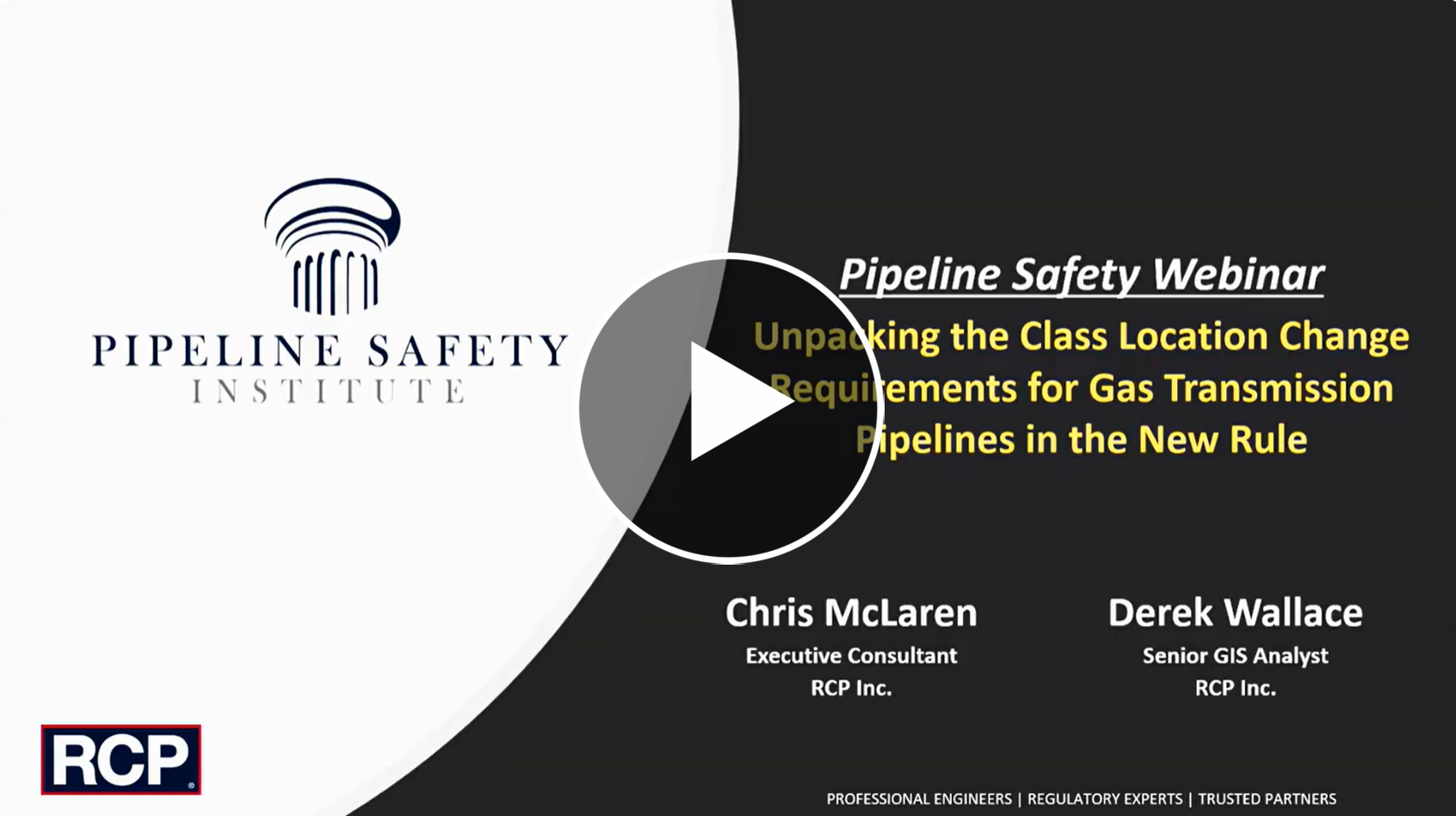
Pipeline Safety: Unpacking the Class Location Change Requirements
Pipeline Safety: Unpacking the Class Location Change Requirements
Thank you to everyone who attended and participated in this informative webinar. The session recording is posted to our YouTube channel. Please watch, like, and subscribe to our channel!
You asked and we listened!
Advanced DOT Pipeline Compliance Workshop is on the calendar!
This intensive and interactive 3-day, in-person workshop is designed for those who have previously completed our DOT Pipeline Compliance Workshop and are ready to take their knowledge to the next level.
New Workshop Alert!
Prepare Your Team for Pipeline Safety Audits with Confidence!
Our 3-day Pipeline Safety Audit Workshop is tailored for professionals responsible for the safe operation of hazardous liquid and natural gas pipelines. Designed for groups of 10-15 participants, this interactive training…
On-Site Training Request
We have conducted on-site training for oil and gas companies for over 25 years and can provide customized workshops for companies with groups of five or more.
We would welcome the opportunity to discuss our services with you.
Sincerely,

W. R. (Bill) Byrd, PE
President
RCP Inc.
- DOT Pipeline Compliance Workshop – October 19 – 21, 2010
- Periodic Updates of Regulatory References to Technical Standards and Miscellaneous Edits
- PHMSA Notice & Request for Comments on Information Collection Activities
- Technical Advisory Committee Meetings
- TSA Pipeline Security Guidelines – Information Collection Request Comment Period
- API Safety Standards Available Online
- Mary McDaniel moving to PHMSA
- Texas Railroad Commission Proposed New Rule Chapter 8 – Pipeline Safety Regulations relating to Distribution Facilities Replacements
- Texas Railroad Commission Adopts New Rules
- Texas Railroad Commission (TRRC) Damage Prevention Meeting
- Vessel and Facility Response Plans for Oil: 2003 Removal Equipment Requirements and Alternative Technology Revisions
- Procedures for Transportation Workplace Drug and Alcohol Testing Programs
- PHMSA Advisory Bulletin ADB-10-07
- Texas Railroad Commission Adopts Repeal & New §3.15 Surface Equipment Removal Requirements and Inactive Wells
- Revision of LNG and LHG Waterfront Facility General Requirements
- NESHAPs for SI RICE
- Regulatory Watch: Key Dates & Deadlines
- Conference News
- PSI Training Schedule